


Commanders Open Preseason with Decisive Victory
The Washington Commanders commenced their 2026 preseason schedule with a commanding 20-7 victory over the Miami Dolphins. The contest, held at Northwest Stadium, served as the preseason opener for both franchises, offering an initial glimpse into roster dynamics and early-season form. While preseason games often prioritize player evaluation over final scores, the 13-point margin of victory for Washington provided a clear indication of their early offensive effectiveness and defensive resilience.
The first half of the game was particularly active, featuring several offensive drives that highlighted specific player matchups and strategic deployments. These early plays allowed coaching staffs to assess individual performances under live-game conditions, a crucial aspect of the preseason evaluation process.
Yankoff's Offensive Drive Highlight
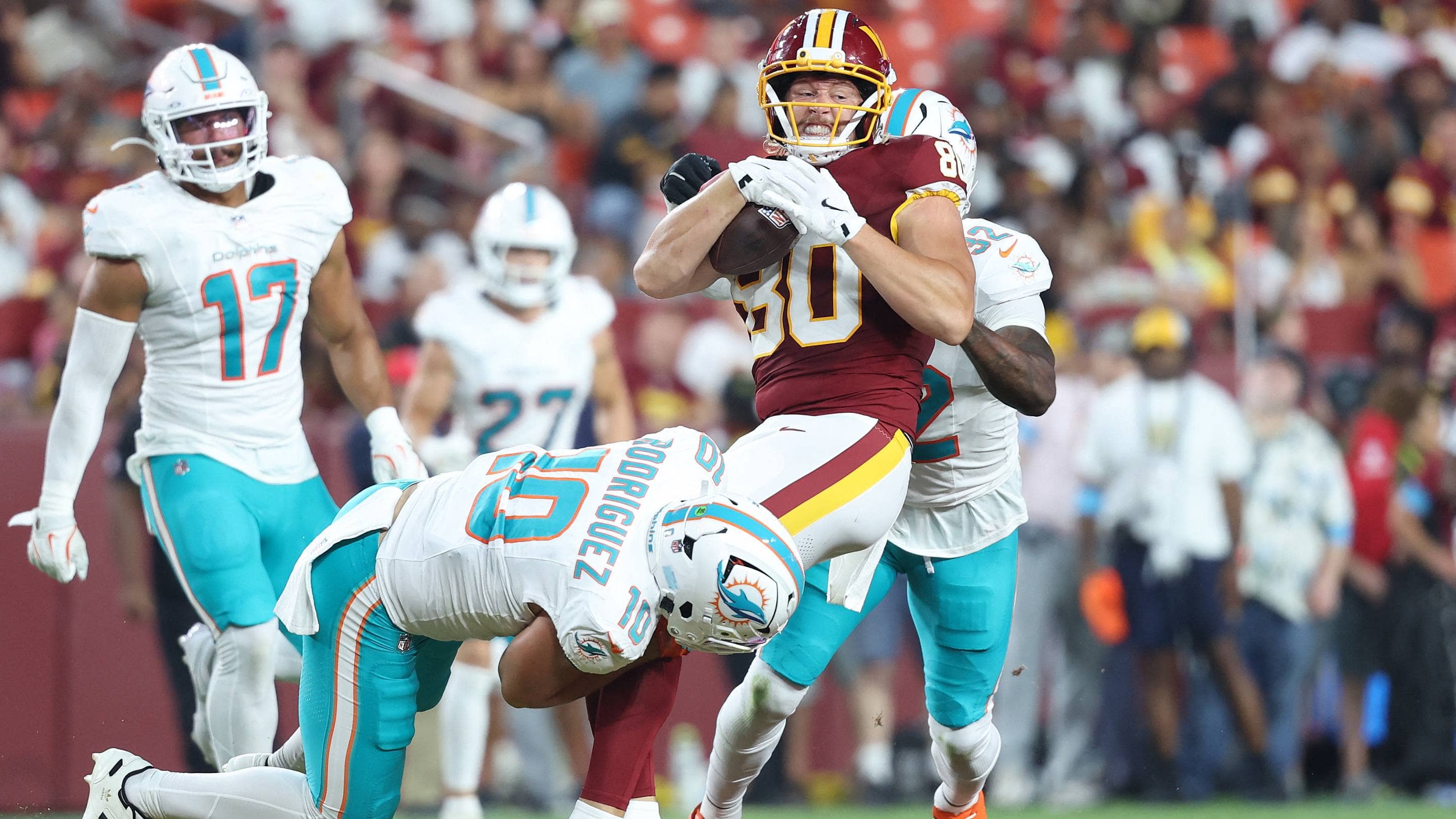
A notable moment during the first half involved Washington Commanders tight end Colson Yankoff, wearing jersey number 80. Yankoff was observed carrying the ball as the Commanders advanced on offense, showcasing his involvement in the team's early offensive schemes. This play drew significant defensive attention from the Miami Dolphins, specifically from linebacker Jacob Rodriguez (number 10) and safety Lonnie Johnson Jr. (number 32).
The interaction between Yankoff and the Dolphins' defensive players provided a snapshot of both the Commanders' offensive line's ability to create running lanes and Yankoff's role as a ball carrier. For the Dolphins, it offered an early test for their defensive coverage and tackling in open-field situations against a dynamic tight end. Such individual battles are critical for coaches to evaluate player readiness and scheme effectiveness before the regular season begins.
Roster Evaluation Dominates Preseason Focus
Beyond the final score, reports surrounding the game heavily emphasized player workload and participation levels. The preseason serves as a vital period for coaching staffs to make critical roster decisions, and the distribution of snap counts is a key metric in this process. Observers and the Dolphins' coaching staff meticulously tracked who played, who rested, and who received extended opportunities, particularly concerning offensive line usage and linebacker deployment.
This granular analysis of player participation helps teams assess depth, evaluate players competing for roster spots, and test new schemes or player combinations. The 20-7 loss for the Dolphins, while not impacting their regular-season record, provided a wealth of data for immediate review and adjustments.
Grayson Murphy's Significant Workload
Among the players whose snap counts drew particular attention was Grayson Murphy. Identified in both pre-game expectations and post-game observations, Murphy reportedly carried a heavy workload during the matchup. A significant workload in a preseason opener can indicate several things: a player competing for a starting role, a coach's desire to evaluate a player's endurance and consistency over extended periods, or an individual on the roster bubble needing every opportunity to prove their value. Murphy's performance under this increased demand will undoubtedly be a key point of analysis for the Dolphins' coaching staff as they refine their roster.
Defensive Deployments Under Scrutiny
On the defensive side of the ball, the usage of linebackers and defensive backs was a primary area of focus. The deployment of Jacob Rodriguez, who was involved in the tackle attempt on Colson Yankoff, along with other defensive backs like Lonnie Johnson Jr., was closely monitored. These observations are crucial for understanding how the team plans to utilize its defensive personnel in various situations, test new coverage schemes, and assess the effectiveness of individual players in their assigned roles.
The ability of the Commanders' offense to move the ball and ultimately secure a 20-7 victory against the Dolphins' defense provided tangible evidence of areas where Miami's defensive unit might need further refinement. The interactions observed, such as the one involving Yankoff, Rodriguez, and Johnson Jr., offer specific examples for coaches to review and address.
Strategic Roster Management
The full rundown of player participation included not only those who played extensively but also details on who did not play or who played more than initially anticipated. This strategic management of the roster in the first preseason game is essential for several reasons, including injury prevention for key veterans, providing opportunities for younger players or those on the fringe of the roster, and evaluating overall team depth. The decisions made regarding player availability and snap distribution are direct reflections of the coaching staff's priorities for roster construction heading into the competitive regular season.
Early Data Points for the 2026 Season
This matchup marked the official beginning of the preseason schedule for the Miami Dolphins, and the loss to Washington provided an immediate set of data points for the team's comprehensive evaluation process. Coaches will meticulously analyze every snap, every play, and every player's performance to make informed decisions about the final 53-man roster. The emphasis on snap counts and player usage underscores the coaching staff's commitment to assessing depth, identifying strengths, and pinpointing areas for improvement under actual game conditions.
The Commanders, conversely, demonstrated early offensive capability, particularly in the first half. Players like tight end Colson Yankoff were actively involved in key plays, successfully challenging NFL defenders and contributing to Washington's scoring efforts. The game at Northwest Stadium served as a critical testing ground for both teams, allowing them to gauge player readiness, experiment with new strategies, and fine-tune their operations in preparation for the upcoming competitive season.
Immediate reports following this specific preseason opener primarily focused on the 20-7 result and the individual player metrics observed during the contest. No other final scores or subsequent games were detailed, reinforcing that the primary objective of this initial outing was internal evaluation and data collection for both the Commanders and the Dolphins.