

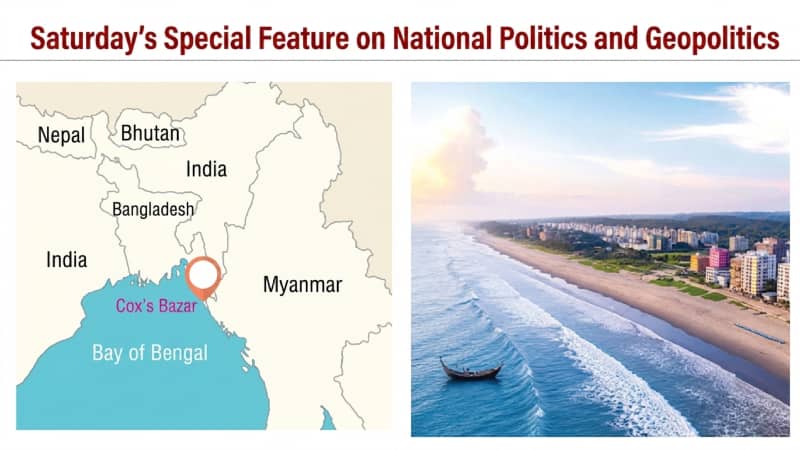

Analysts state that growing connectivity plans, critical energy projects, and persistent cross-border crime are currently reshaping the national and regional significance of Cox's Bazar. The town serves as a focal point where history, borders, and contemporary economic infrastructure converge to define its strategic importance.
A Historical Legacy Defined by Refugee Resettlement
The district’s origins trace back to Captain Hiram Cox in the late 18th century. An officer of the British East India Company, Captain Cox arrived in Ramu during late 1798 or early 1799 with a specific mandate: to resettle Arakanese refugees.
Company officials originally intended to relocate this displaced population toward northern Chattogram. However, Captain Cox selected an alternative location for the settlement instead. He chose the southern strip situated between the Bakkhali and Naf rivers. On the banks of the Bakkhali, at a site that corresponds to today’s modern town centre, he established a market.
Following this establishment, he settled the refugees in the area. This settlement was initially named “Cox er Bazaar” in his honour before subsequently evolving into Cox's Bazar as known today. The decision marked a divergence from standard Company policy regarding refugee placement at that time.
Mandates Beyond Immediate Relief
Captain Cox’s mandate extended well beyond the immediate relief of refugees. His responsibilities encompassed forest cultivation, agricultural expansion, and revenue generation for the administration.
Furthermore, he oversaw the implementation of a defensive perimeter on British India's eastern frontier. This security measure was designed specifically to counter raids from Burma and hill tribes in the region. The establishment of this perimeter defined the strategic nature of the location even before independence.
The Enduring Triad of Borders and Security
More than two centuries later, Cox's Bazar continues to reflect the legacy established by Captain Hiram Cox. Analysts observe that the triad of refugees, borders, and security which originally defined its strategic importance still endures in the present day.
This historical foundation is now compounded by several modern factors. These include shifting geopolitics within the Bay of Bengal, issues regarding human trafficking, narcotics smuggling networks, and critical economic infrastructure projects such as the Matarbari Deep Sea Port.
The beach town currently operates simultaneously as one of the country’s most sensitive locations due to these overlapping pressures. The convergence of historical refugee resettlement with modern cross-border crime creates a complex security environment that local officials monitor closely.
Geopolitical Shifts in the Bay of Bengal
The region faces new geopolitical dynamics driven by connectivity initiatives and energy projects. These developments are altering the landscape of Bangladesh's southernmost district on multiple levels.
Critical economic infrastructure like the Matarbari Deep Sea Port represents a significant shift in regional logistics and trade capabilities. The port’s development is linked to broader strategic interests involving neighboring nations and maritime routes through the Bay of Bengal.
Security Challenges Persist
Persistent cross-border crime remains a defining feature of the district's current reality. Human trafficking cases are reported alongside incidents related to narcotics smuggling. These activities complicate the security situation established by Captain Cox’s original defensive perimeter two centuries ago.
The Bay of Bengal geopolitical context adds another layer of complexity to these issues. Regional instability and maritime disputes influence local law enforcement priorities in Cox's Bazar district.