

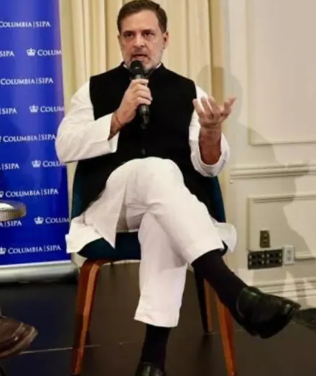

Claims Made at Columbia University
\nRahul Gandhi, speaking at Columbia University in New York, declared that India was facing an \"economic disaster\" and had broken its economic spine. During the address, he argued that the country had effectively given up on manufacturing and questioned why only businesses associated with Adani and Ambani were growing.
\nGandhi also asked where private investment was located within the current economic framework. His comments framed the national economy as being in a state of collapse, specifically targeting the lack of broad-based industrial growth and private sector expansion.
\n\nReserve Bank Data Shows Growth in GDP and Manufacturing
\nRevised figures reported by the Reserve Bank of India (RBI) indicate that India’s real gross domestic product (GDP) grew by 7.8% in the fiscal year 2025-26. This growth rate was maintained year-on-year in the April-June 2026 quarter, according to the same revised data.
\nWithin the manufacturing sector, real gross value added grew by 8.8% in 2025-26 and accelerated to 9.2% in the April-June 2026 period. Manufacturing accounted for 15.6% of national gross value added in 2025-26, with year-on-year manufacturing output growth recorded at 9% in August.
\nIndustrial production data further highlights specific sectoral increases. Electrical equipment output rose by 27%, while computers, electronic, and optical products increased by 12.4%. Machinery and equipment output grew by 9.1% during the same reporting period.
\n\nRising Private Investment and Financing
\nAn RBI Bulletin study found that banks and financial institutions sanctioned financing for 1,032 private corporate projects in 2025-26. The combined cost of these projects was Rs 4.4 lakh crore, compared to 907 projects valued at Rs 3.7 lakh crore in the previous year.
\nWhen including overseas commercial borrowing and public offerings, investment intentions reached Rs 5.6 lakh crore across 1,839 projects in 2025-26. This represents an increase from Rs 5 lakh crore across 1,589 projects in the prior year.
\nDuring the April-June 2026 quarter, real private consumption rose by 7.1%, and real fixed investment increased by 11.9%.
\n\nInternational Forecasts and Remaining Challenges
\nThe International Monetary Fund (IMF) raised its forecast for India’s growth in 2026-27 from 6.4% to 7% in October. The IMF also projected global growth of 3.1% for the calendar year 2026.
\nDespite the data on GDP, manufacturing output, and private financing, the country continues