


New Delhi Enters US-Led Coalition for Trusted Tech Supply Chains
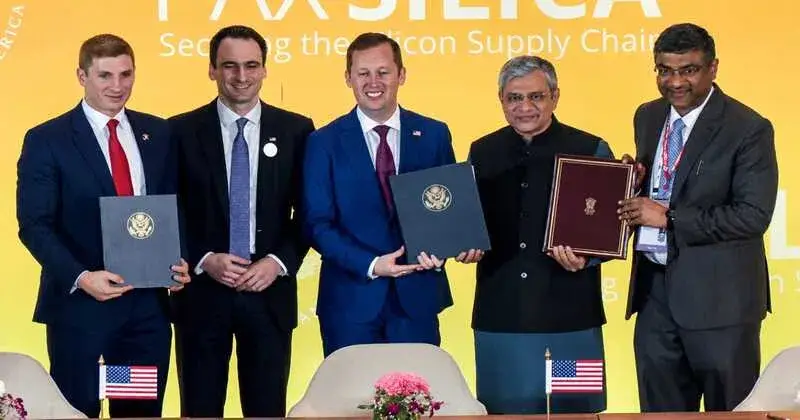
India formally joined the Pax Silica initiative in February 2026, marking a significant expansion of its technological and diplomatic alignment with the United States. The entry places New Delhi at the center of an emerging ecosystem focused on artificial intelligence, semiconductor manufacturing, and critical minerals. Union Minister Ashwini Vaishnaw, US Ambassador to India Sergio Gor, and US Under Secretary of State Jacob Helberg were present at a ceremony in New Delhi to mark the occasion.
The Pax Silica coalition was established by the United States as a strategic partnership designed to build trusted technology supply chains among allied nations. The primary objective of the initiative is to reduce global reliance on China for advanced technology components and infrastructure. By joining this framework, India has aligned itself with a network of countries working to secure the foundational elements of the digital economy.
According to analysis published by Organiser Weekly, the move represents one of India's most consequential strategic decisions in the technology domain since the India-US Civil Nuclear Agreement. The publication describes the development as a "strategic game changer" that shifts the focus of global power dynamics toward control over computing infrastructure and advanced manufacturing capabilities.
Commitment to AI Opportunity and Semiconductor Cooperation
At the second Pax Silica Summit held in Washington, India joined thirty-four other countries in endorsing the Joint Statement on AI Opportunity. This endorsement commits participating nations to a pro-growth and pro-innovation approach toward artificial intelligence development. The statement signals a coordinated effort among member states to foster technological advancement while establishing common standards for the industry.
India's participation grants it a position at the table where future regulations governing AI infrastructure, semiconductor manufacturing, and technology supply chains will be shaped. The initiative seeks to integrate the entire artificial intelligence value chain into a resilient production network. This integration extends beyond software development to include the sourcing of critical minerals essential for advanced electronics.
The coalition also emphasizes cooperation in energy infrastructure required to power AI data centers. By addressing these foundational components, Pax Silica aims to create a secure and reliable supply chain for the next generation of computing technologies. The focus on semiconductor manufacturing highlights the strategic importance of hardware production in the broader geopolitical landscape.
Strategic Autonomy and Industrial Transformation
New Delhi views its involvement in Pax Silica as an opportunity to accelerate domestic industrial transformation. The government aims to leverage the coalition to strengthen its own technological base while safeguarding long-term strategic autonomy. This dual objective reflects a broader trend among emerging powers to engage with Western-led initiatives without fully ceding policy independence.
The competition for dominance in artificial intelligence and related technologies has shifted from traditional military power to control over critical resources. The landscape now revolves around semiconductors, critical minerals, computing infrastructure, advanced manufacturing, and AI ecosystems. India's entry into Pax Silica positions the country to influence these emerging standards while developing its domestic capacity.
Observers note that the initiative promotes cooperation among like-minded countries to build trusted technology supply chains. This approach contrasts with previous technology partnerships that were largely confined to research collaborations or software development. The current framework encompasses a wider range of industrial and strategic activities, from raw material extraction to final product assembly.
Implications for Global Technology Geopolitics
The establishment of Pax Silica underscores the growing importance of trusted technology supply chains in international relations. As artificial intelligence reshapes global power structures, access to secure and reliable components has become as critical as energy and trade resources. India's alignment with this US-led coalition signals a clear preference for partnerships that prioritize security and innovation.
The involvement of thirty-four countries in the Joint Statement on AI Opportunity demonstrates a broad consensus among member states regarding the direction of technological development. This collective commitment to pro-growth policies may influence global markets and regulatory environments in the coming years. The focus on reducing dependence on China for technology components is expected to reshape supply chain dynamics across multiple industries.
India's formal accession to the initiative in February 2026 coincides with a period of intensified competition in the global technology sector. The country's ability to balance its strategic autonomy with the benefits of international cooperation will be a key factor in determining the long-term impact of Pax Silica. The outcomes of this partnership will likely influence not only India's domestic industrial landscape but also the broader geopolitical balance of power.