


Structural Foundations Of A Pluralistic Political Model
The political architecture of the Lebanese Republic is defined by a confessional power-sharing system. This model operates on principles often described within academic and political science circles as consociational governance. The design intent behind this structure was to distribute authority among the country's primary religious communities rather than relying solely on individual or secular citizenship models.
Proponents of this arrangement argue that guaranteed communal representation offers a higher probability for achieving political stability in a society characterized by deep pluralism and a history marked by violent fragmentation. The underlying belief driving the establishment of this system is that majoritarian democracy alone might not suffice to maintain cohesion among distinct groups with historical grievances.
According to demographic data associated with the country, the population composition relevant to this power-sharing framework includes Shi'a communities comprising approximately 30-35 percent of the total. Sunni populations are estimated at between 25 and 30 percent. Christian representation falls within a range of roughly 30 to 35 percent. Druze communities constitute around five percent of the demographic makeup.
These specific percentages form the basis for allocating seats in parliament, government ministries, and high offices such as the presidency and speakership of Parliament. The system ensures that no single religious group can dominate the state machinery without the consent or participation of others, theoretically preventing any one faction from imposing its will on the entire nation.
Recent Social Unrest Targeting State Institutions
The operational stability of this governance model has recently been subjected to significant scrutiny following a wave of social unrest. Protests began in October and continued into January 2020, creating a period described by demonstrators as an ongoing demand for political reform.
During the escalation beginning in late autumn, protesters resumed blocking major highways across the nation. Demonstrators framed these actions as part of what they termed a "week of wrath." The primary objective articulated during this phase was to force an end to nearly three months of perceived political vacuum within the state institutions.
The focus of public anger shifted specifically toward banks and government bodies. Protesters blamed financial institutions for driving the country toward economic collapse, alongside accusations against state leadership for failing to address corruption and mismanagement. Despite reports indicating that the size of demonstrations had declined in certain weeks following their peak intensity, the protests remained active throughout January 2020.
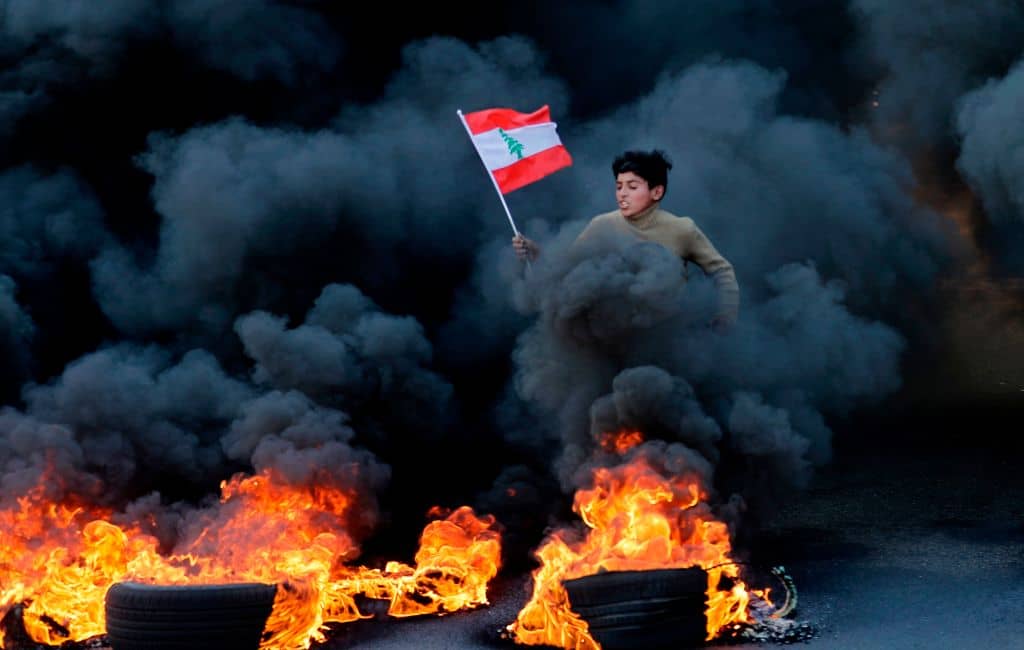
Visual documentation from Jal el-Dib area on the northern outskirts of Beirut captured these tensions vividly. On January 14, 2020, a demonstration took place where smoke billowed from burning tires while a Lebanese youth ran with a national flag. The imagery underscored the volatile atmosphere surrounding the political vacuum that demonstrators sought to resolve.
These events occurred against a backdrop of broader economic deterioration and public dissatisfaction with the status quo. Critics within Lebanon argued that existing power-sharing arrangements had become entangled in corruption, rendering them ineffective at delivering services or ensuring accountability for citizens regardless of their religious affiliation.
External Pressures Testing Internal Cohesion
The current geopolitical environment adds another layer of complexity to the functioning of this system. Escalating military action involving Israel has placed Lebanon's internal political mechanisms under extreme pressure. Military developments on the border have forced security forces and government officials to navigate a landscape where external threats intersect with domestic instability.
Experts observing the situation note that the confessional system is being stress-tested in real time. The question facing analysts and policymakers alike involves whether this form of consociational governance can preserve internal cohesion when faced with such severe external shocks.
The interplay between regional conflicts and domestic politics has created a scenario where traditional mechanisms for resolving disputes may be insufficient to address immediate security concerns. As military actions escalate, the ability of different religious communities to maintain unity becomes increasingly critical yet challenging.
Opposing views on how best to respond to these pressures vary among political leaders within Lebanon. Some factions advocate for strengthening internal alliances across sectarian lines to present a unified front against external aggression. Others argue that focusing solely on security matters risks undermining the very power-sharing agreements intended to prevent civil conflict in the first place.
The situation remains fluid, with ongoing developments affecting both the military and political landscapes of Lebanon. The effectiveness of the confessional system will likely depend heavily on how various stakeholders choose to prioritize national unity versus sectarian interests during times of heightened crisis.