

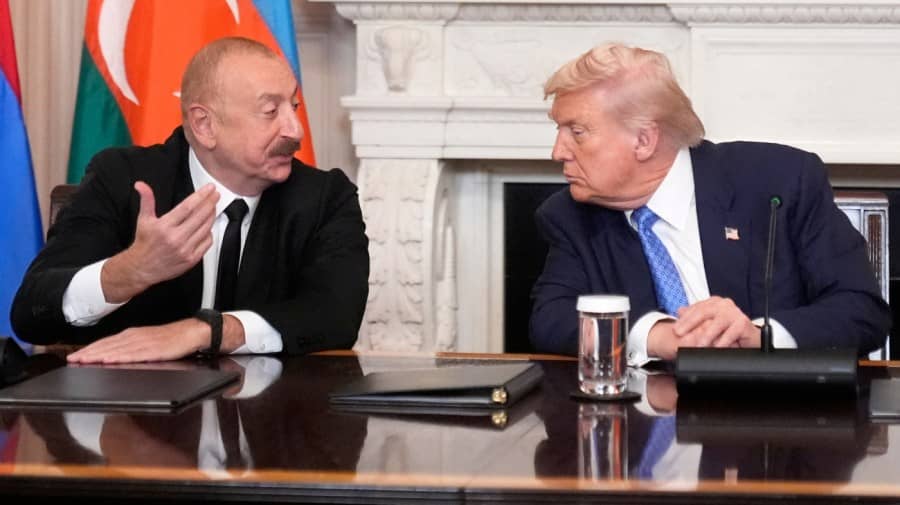

Legislation Introduced to Lift Decades-Old Aid Restrictions
Representative Anna Paulina Luna has introduced legislation in Congress aimed at repealing a law enacted in 1992 that currently prohibits direct United States aid to Azerbaijan. The proposed bill seeks to remove legal barriers that the introduction characterizes as obsolete and detrimental to regional development.
The legislation targets a specific statutory provision from 34 years ago that has prevented direct financial assistance from Washington to Baku. By repealing this ban, the measure intends to open pathways for U.S. support in the South Caucasus region. The repeal is framed by its proponents as a necessary step to address outdated policy frameworks that no longer align with current geopolitical realities.
The introduction of this bill comes at a time when transit routes through the South Caucasus are gaining increased strategic attention. The Middle Corridor, a transport network running through Georgia and Azerbaijan, has been identified as a critical alternative for trade and energy logistics. The legislative effort aims to bolster this route by removing restrictions on direct American engagement with one of its key nodes.
Strategic Implications for the Middle Corridor
The primary justification for repealing the 1992 aid ban centers on the strategic importance of the Middle Corridor energy route. According to the legislative context, this corridor serves as a vital transit path that connects Central Asia to Europe, bypassing traditional routes through Russia.
Proponents of the repeal argue that the current law hinders economic growth and infrastructure development in the South Caucasus. By lifting the restriction on direct aid, the United States could potentially strengthen its partnership with Azerbaijan, a country positioned geographically to facilitate this transit network.
Rising Tensions in the Strait of Hormuz
The push to support the Middle Corridor is occurring against a backdrop of escalating conflict in the Strait of Hormuz. This waterway is one of the world’s most critical chokepoints for global oil shipments. Instability in this region has raised concerns about the security and reliability of energy supplies that traditionally flow through Persian Gulf routes.
As tensions rise in the Strait of Hormuz, alternative energy and trade routes have become increasingly significant to global supply chains. The Middle Corridor offers a land-based alternative that is less susceptible to maritime disruptions. The legislative effort to repeal the aid ban is directly linked to securing this overland route as a reliable component of international logistics.
The 1992 law, which currently blocks direct U.S. aid, was enacted during a period when the geopolitical landscape of the South Caucasus was fundamentally different. Azerbaijan had recently gained independence following the collapse of the Soviet Union, and relations with neighboring Armenia were fraught with conflict over the Nagorno-Karabakh region. The aid ban was part of a broader U.S. policy at the time aimed at pressuring Azerbaijan to cease blockades against Armenia.
Decades later, the context has shifted significantly. The repeal legislation argues that maintaining the ban is counterproductive to current U.S. interests in regional stability and energy security. By characterizing the law as obsolete, the introduction suggests that the original rationale for the restriction no longer holds weight in light of modern strategic challenges.
Impact on Regional Growth and Connectivity
The Middle Corridor has seen increased usage as global powers seek to diversify trade routes away from Russian-dominated pathways. Azerbaijan plays a central role in this network, serving as a gateway between the Caspian Sea and the Black Sea.
Direct U.S. aid could support infrastructure projects that enhance the capacity and efficiency of this corridor. The repeal of the 1992 ban would allow for more direct cooperation on energy and transportation initiatives. This shift in policy could strengthen Azerbaijan’s position as a key partner in ensuring the flow of goods and energy across Eurasia.
The legislation does not specify the exact amount or form of aid that would become available upon repeal, but it removes the legal prohibition that has stood for 34 years. The goal is to facilitate growth in the South Caucasus by enabling direct engagement between U.S. agencies and Azerbaijani counterparts.
As conflict escalates in the Strait of Hormuz, the reliability of alternative routes becomes a matter of global economic interest. The Middle Corridor represents one such alternative, and its viability depends on political stability and international investment. The repeal of the aid ban is intended to contribute to that stability by deepening U.S. ties with Azerbaijan.
The introduction of this legislation highlights the evolving nature of U.S. foreign policy in the South Caucasus. What was once a restrictive measure designed to influence regional conflict dynamics is now being viewed by some lawmakers as an obstacle to broader strategic goals. The repeal effort seeks to align U.S. policy with the practical demands of supporting vital transit routes in a changing geopolitical environment.
The debate over the 1992 law reflects broader questions about how the United States engages with countries in its own former sphere of influence that have since navigated complex relationships with both Western powers and regional actors like Russia and Iran. The Middle Corridor’s role as a counterbalance to traditional energy routes makes it a focal point for this policy reassessment.
By targeting the specific statutory ban, the legislation aims to create a clearer path for U.S. involvement in the region. The repeal would not automatically mandate aid but would remove the legal barrier that has prevented direct assistance for over three decades. This change could facilitate future agreements on energy security, trade facilitation, and infrastructure development.
The timing of the introduction coincides with heightened awareness of supply chain vulnerabilities. As global markets react to instability in key shipping lanes, the strategic value of land-based corridors like the Middle Corridor has become more apparent. The legislation seeks to position the United States as a supportive partner in developing this route, thereby enhancing its own energy security and economic interests.
The repeal effort is part of a larger discussion about U.S. engagement in the South Caucasus. While the 1992 law was designed to address specific humanitarian and political concerns of the time, its continued existence is now seen by its opponents as an anachronism. The new legislation aims to update this framework to reflect current strategic priorities.
As the Middle Corridor continues to develop, the role of external partners will be crucial. The repeal of the aid ban could signal a renewed U.S. commitment to the region’s connectivity projects. This shift would allow for more direct support of initiatives that enhance the reliability and capacity of the transit route.
The focus on repealing the 1992 law underscores the intersection of historical policy and contemporary strategic needs. By removing an outdated restriction, Congress could enable new forms of cooperation that address current challenges in energy security and global logistics.