


Exhibition Focuses on Geopolitical History Through Stamps
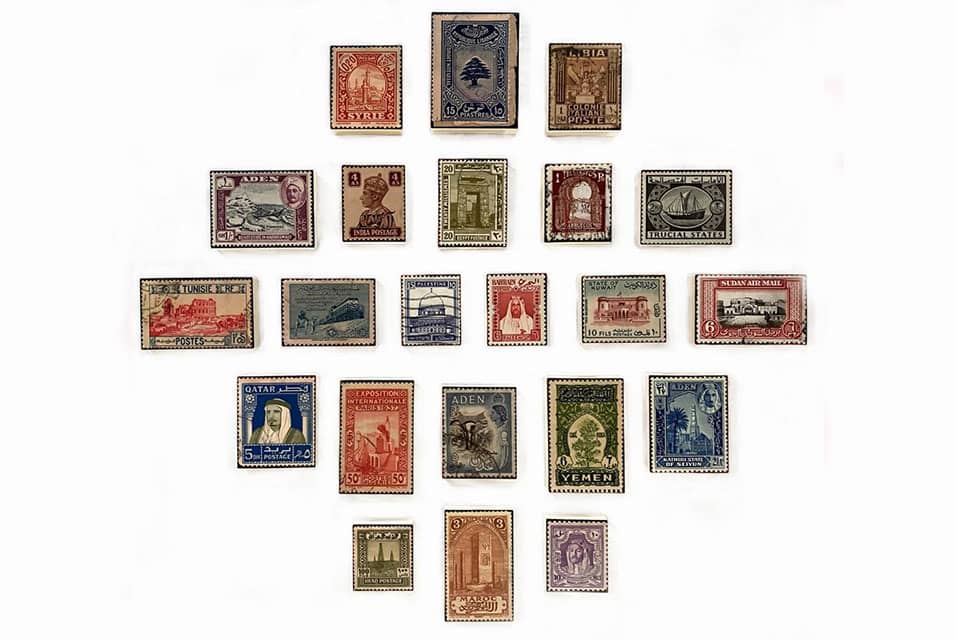
Marie Jose Gallery in London has opened a solo exhibition by artist Matthew Corbin Bishop titled 'One of the first things I ever bought was a globe.' The show centers on Bishop’s long-term project, 'The Making of the Modern World,' which utilizes postage stamps as a primary medium to explore global history and national identity.
Bishop, who was born in 1984 and grew up in Southampton, England, stated that his interest in geopolitics began in childhood. He described being surrounded by symbols of nations, including atlases, books of flags, and maps, which he sketched as a young boy. By age seven, he had purchased his first globe. His early education involved memorizing every world capital and national flag, while also collecting currencies and inheriting his grandfather’s stamp collection.
The current exhibition stems from this lifelong fascination with nations. Bishop noted that the project has been a focus for over 15 years. He explained that postage stamps serve as the central element of his work, allowing him to reimagine the world through "visual currency." Throughout the development of the project, he read extensively to understand the colonial history of Europe and the Ottoman Empire.
Bishop asserted that this research informed new ideologies and methods of working. At the core of his practice is the notion that while nationality and patriotism can be unifying forces, they are also drivers of extremism and the creation of "the other." He described his practice as often conceptual, drawing extensively on archival imagery, including historical documents and maps.
Historical Context and Colonial Commentary
The exhibition pairs two distinct historical periods: gouache paintings from the mid-19th century depicting Europe in 1859 before German and Italian unification, and representations of the Middle East after the Great War. Bishop linked the aspiration to join European Empires to the dismantling of the Ottoman Empire.
He stated that tragic policies enacted since the empire's dissolution have blighted the Middle East. According to Bishop, arbitrary divisions continue to disrupt the balance of states and peoples in the region. He expressed hope that the exhibition would shine a light on this history while presenting the paintings as beautiful historical documents and artifacts.
Bishop described the exhibition as a comment on Britain’s colonial past, which he claims is often overlooked by the UK schooling system in favor of focusing on oppressors and colonists. This commentary traces back to an initial grouping titled 'The British Empire,' shown at the Truman Brewery in July 2008.
That earlier show included 80 stamps representing countries that were colonies, dominions, and protectorates of the British Empire at its peak, ranging from pre-World War I to post-World War II. The current exhibition continues this lineage by examining how these historical boundaries continue to influence modern geopolitical tensions.
Artistic Origins and Academic Foundation
Bishop’s approach to art is deeply rooted in his academic background. He began studying for a BA (Hons) at Bath Spa University in 2005, where he likely began to formalize the interests that would later define his career. His work does not merely display historical artifacts but actively interrogates the systems of power that created them.
By using postage stamps, Bishop highlights how nations are constructed and maintained through visual symbols. These small, mass-produced items serve as evidence of state authority and territorial claims. The exhibition invites viewers to consider how these symbols have been used to justify colonial expansion and subsequent conflicts.
The juxtaposition of 19th-century European maps with post-World War I Middle Eastern borders underscores the long-term consequences of imperial decisions. Bishop’s work suggests that the current political landscape is not a natural occurrence but the result of specific historical choices made by colonial powers.
Visual Currency and National Identity
The use of postage stamps as "visual currency" allows Bishop to explore the economic and political value placed on national identity. Stamps are objects that traverse borders, yet they also reinforce those borders through their design and issuance.
Bishop’s research into the Ottoman Empire and European colonial history reveals how these powers manipulated local identities for their own benefit. The arbitrary divisions drawn by colonial administrators have had lasting effects on the region, contributing to ongoing instability.
Through his paintings and stamps, Bishop offers a critical perspective on how history is taught and remembered. He challenges the viewer to look beyond the official narratives of empire and consider the perspectives of those who were colonized.
The Legacy of Colonialism in Contemporary Art
The exhibition at Marie Jose Gallery serves as a platform for discussing the enduring legacy of colonialism. Bishop’s work connects past events with present-day issues, showing how historical injustices continue to shape contemporary politics.
By presenting these works as both art and historical documents, Bishop blurs the line between aesthetic appreciation and political critique. The beauty of the gouache paintings contrasts with the harsh realities they depict, creating a powerful emotional impact.
The exhibition encourages viewers to reflect on their own relationship with national identity and history. It asks difficult questions about who is included in the narrative of modern world history and who is left out.