

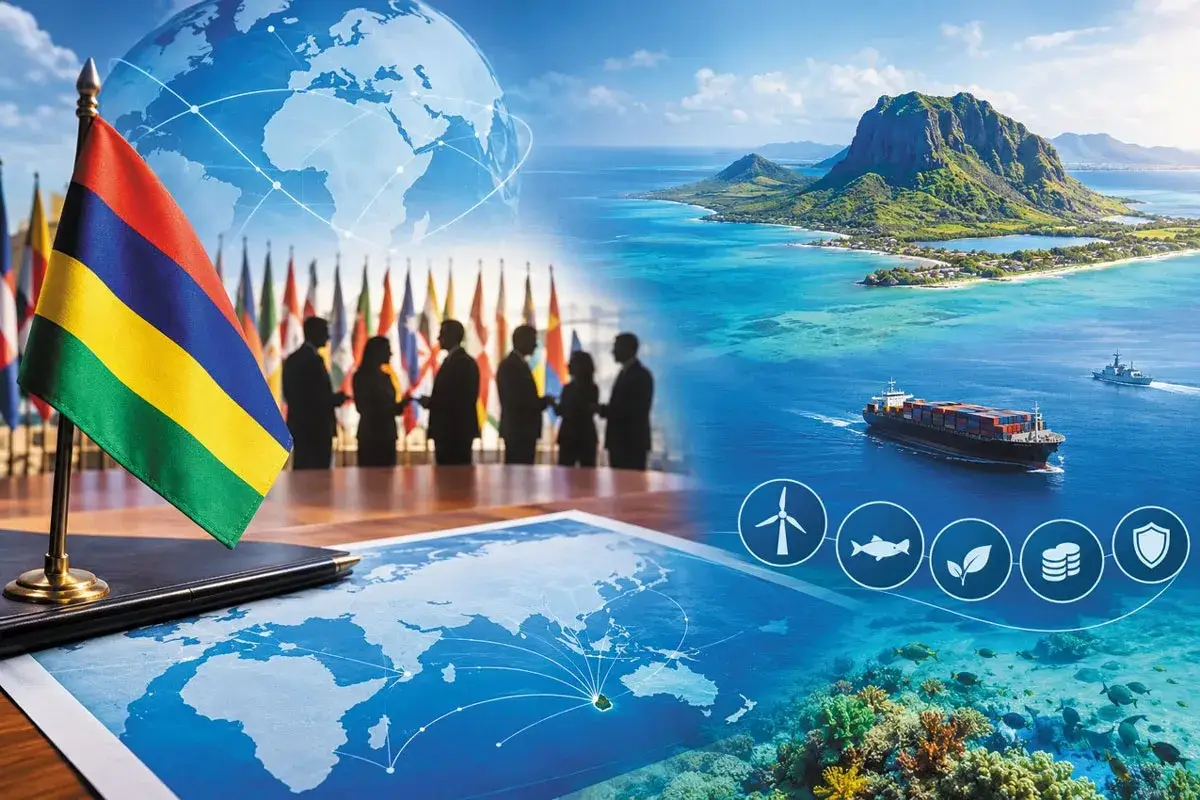

Defining Agency in an Uncertain International Order
In a recent analysis published by Mauritius Times, Vijay Makhan asserts that while small states cannot command global events, they retain the capacity to define their national interests and utilize diplomacy to expand their strategic options. Makhan writes that the international order is currently experiencing "profound uncertainty" driven by a return of great-power rivalry.
According to Makhan, this competition has expanded beyond traditional military strength to encompass trade, technology, energy, finance, communications, and maritime routes, all of which have become instruments of influence. He notes that while multilateral institutions remain indispensable, their authority is frequently tested when powerful states determine that existing rules are inconvenient for their interests.
Makhan emphasizes that the consequences of these global shifts are immediate for smaller nations. He lists specific impacts including fluctuations in fuel prices, food supplies, shipping costs, and the security of essential communications. Additionally, he identifies climate change as adding another layer of exposure to these vulnerabilities.
Coalition Building and Historical Precedents
Despite lacking the economic or military weight of larger countries, Makhan argues that small states possess other instruments of power. These include establishing clear national interests, building coalitions, working through regional organizations, and invoking international law.
To illustrate how limited individual weight can influence negotiations, Makhan points to his tenure leading OAU/AU delegations at World Trade Organization (WTO) Ministerials in Seattle in 1999 and Cancun in 2003. He recalls witnessing how countries with limited power could affect outcomes by acting together.
Specifically, Makhan highlights the role of the G90 group during the Cancun Ministerial. He states that this coalition gave collective expression to the view that development could not be treated as an afterthought, helping to change the terms of discussion despite significant power disparities among the participants.
Mauritius’s Geographic and Diplomatic Assets
Regarding Mauritius specifically, Makhan outlines the country's diplomatic reach, which he attributes to connections with Africa and Asia, participation in regional organizations, and engagement with the wider Indian Ocean region. He notes that the nation's geography necessitates a wider national outlook because its maritime domain extends across space far greater than its land territory.
This geographic reality offers possibilities in marine science, renewable energy, and sustainable resource use, while simultaneously bringing responsibilities for biodiversity protection and maritime surveillance.
Makhan cites Mauritius's perseverance on the Chagos issue as evidence that a small state guided by principle and sustained diplomatic effort need not accept that power alone determines outcomes. However, he adds the caveat that Mauritius is "yet to savour the fruits thereof" regarding this long-standing dispute.
Strategic Roadmap for Future Policy
Makhan argues that agency requires careful preparation, including clear priorities, capable institutions, and a national understanding of how interests in diplomacy, security, and economic development connect. He emphasizes that this internal coherence is essential for navigating the complex geopolitical landscape.
To provide a concrete framework for such preparation, Makhan has proposed a ten-year strategic roadmap in his book Geopolitics of the Indian Ocean. This proposal offers options across several sectors and establishes a framework for connecting specific choices, such as maritime surveillance with regional cooperation. By adopting such a structured approach, Mauritius can better leverage its unique position to secure its interests in an increasingly volatile world.