

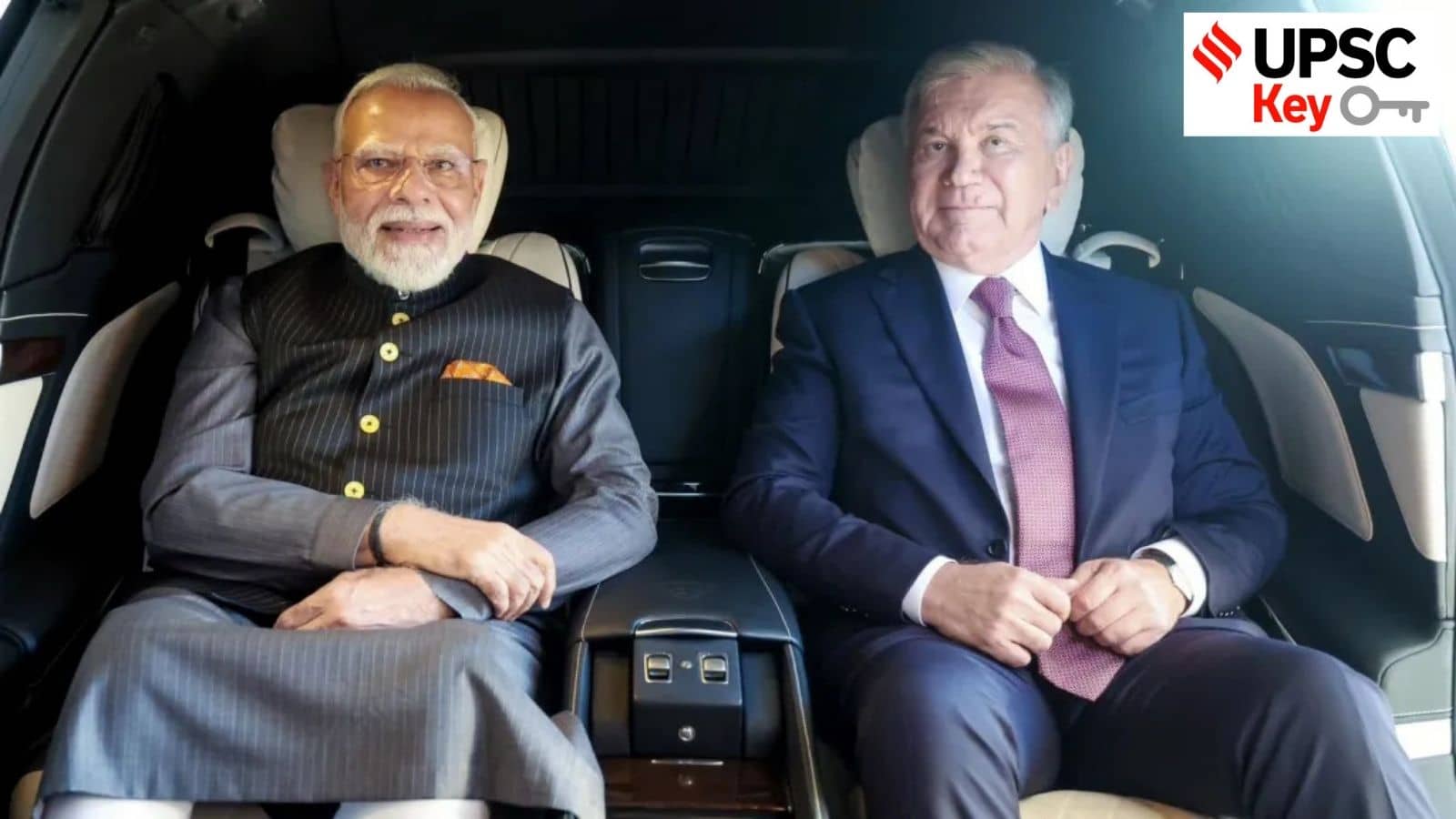

Modi Begins Four-Day Central Asia Trip in Tashkent
Prime Minister Narendra Modi commenced a four-day diplomatic trip to Central Asia on Saturday, initiating his visit with Uzbekistan. The journey began in the capital city of Tashkent, where Modi held a dinner meeting with Uzbekistan’s President Shavkat Mirziyoyev. During this initial engagement, both leaders pledged to deepen cooperation across various sectors.
The visit marks a significant step in bilateral relations between India and Uzbekistan. According to reports from the Indian Express, the Prime Minister highlighted a "shared vision" that encompasses multiple areas of mutual interest. This vision specifically includes cooperation in trade, culture, energy, and defence. The discussions during the dinner meeting set the tone for subsequent engagements planned throughout the four-day itinerary.
Visual records from the event show Modi sharing a car ride with President Mirziyoyev in Tashkent on Saturday, illustrating the close diplomatic engagement between the two nations. The Indian Express noted that this trip is part of a broader strategy to strengthen ties in Central Asia, a region of growing strategic importance for India.
India-Uzbekistan Relations and Bilateral Cooperation
The focus of the PM's visit extends beyond ceremonial engagements to substantive policy alignment. The Indian Express reported that Modi flagged a "shared vision" during his interactions in Tashkent. This framework aims to integrate economic and strategic interests between New Delhi and Tashkent.
Cooperation in trade is a central pillar of this relationship. Both nations have expressed interest in expanding commercial links, which could facilitate greater movement of goods and services. The energy sector also features prominently in the agreed-upon agenda, reflecting Uzbekistan's role as a regional energy producer and India's growing demand for diversified energy sources.
Defence cooperation remains another critical component of the bilateral relationship. The pledge to deepen ties in this area suggests potential advancements in military hardware, joint exercises, or intelligence sharing. Cultural exchanges are also part of the shared vision, aiming to foster people-to-people contacts and historical connectivity between the two countries.
UPSC Examination Relevance of Geopolitical Events
The Indian Express has identified the Prime Minister's visit to Uzbekistan as a critical topic for candidates preparing for the Union Public Service Commission (UPSC) Civil Services Examination. The publication explicitly states that knowledge of India-Uzbekistan relations is relevant for both the Preliminary and Mains examinations.
Preliminary Examination Focus
For the Preliminary Examination, the visit falls under the syllabus category of "Current events of national and international importance." Candidates are expected to understand the geopolitical implications of India's engagement with Central Asian nations. The four-day trip itself provides a timeline for current affairs tracking, while the specific sectors mentioned—trade, culture, energy, and defence—offer concrete points for potential multiple-choice questions.
Mains Examination Syllabus Alignment
In the Mains Examination, the topic aligns with General Studies-II. The syllabus requires candidates to analyze "Bilateral, Regional and Global Groupings and Agreements involving India and/or affecting India’s interests." The dinner meeting in Tashkent and the subsequent pledges made by Modi and Mirziyoyev serve as primary case studies for this section.
The Indian Press noted that understanding the strategic context of Central Asia is essential for answering Mains questions related to India's foreign policy. The emphasis on a "shared vision" provides a framework for discussing how India positions itself in regions traditionally influenced by other global powers.
Other Key Topics for UPSC Aspirants
Beyond the PM's diplomatic travels, the Indian Express highlighted several other topics significant for the August 30, 2026 UPSC Key. These include the Sardar Patel National Unity Award, the Red hexagon label, and issues related to the Western Ghats and IBC haircuts.
Sardar Patel National Unity Award
The Sardar Patel National Unity Award was cited as a relevant topic for the examination. This award recognizes contributions to national integration and unity. Candidates are advised to review the criteria for this award and the recipients in recent years to prepare for potential questions on national honors and civic values.
Red Hexagon Label and Environmental Concerns
The Red hexagon label was also identified as a key subject for both preliminary and main examinations. While specific details of the label's regulatory framework were not elaborated in the summary, its inclusion suggests it pertains to environmental or industrial standards that candidates must understand. The Indian Express emphasized that such technical labels often form the basis of questions regarding policy implementation and regulatory compliance.
Western Ghats and IBC Haircuts
Additional topics mentioned include the Western Ghats and IBC haircuts. The Western Ghats, a biodiversity hotspot, frequently appear in examinations related to geography, ecology, and environmental conservation. The term "IBC haircuts" likely refers to insolvency processes under the Insolvency and Bankruptcy Code, a topic relevant to economics and governance.
The Indian Express stated that these diverse topics hold significance for both the preliminary and main examinations. Aspirants are encouraged to review the August 30, 2026 UPSC Key provided by the publication to gain deeper insights into how these specific events and concepts are linked to the exam syllabus.
Exam Preparation Strategy
The Indian Express advises candidates to integrate current geopolitical developments with static syllabus content. The PM's visit to Uzbekistan is not merely a news event but a case study for understanding India's foreign policy objectives in Central Asia. Similarly, the Sardar Patel National Unity Award connects historical figures with contemporary civic responsibilities.
For the Preliminary Examination, candidates should focus on factual details such as dates, locations, and key agreements signed during the visit. The dinner meeting in Tashkent and the specific sectors of cooperation—trade, culture, energy, and defence—are potential areas for direct questioning.
In the Mains Examination, the emphasis shifts to analysis. Candidates must be prepared to discuss the strategic implications of India-Uzbekistan relations, particularly in the context of regional stability and economic integration. The "shared vision" articulated by Modi provides a narrative structure for such discussions.
The inclusion of topics like the Red hexagon label and Western Ghats underscores the breadth of the UPSC syllabus. These subjects require candidates to stay updated on regulatory changes, environmental policies, and economic reforms. The Indian Express suggests that reviewing these topics in the context of the August 30, 2026 key will help aspirants identify patterns in question setting and prioritize their study materials accordingly.