

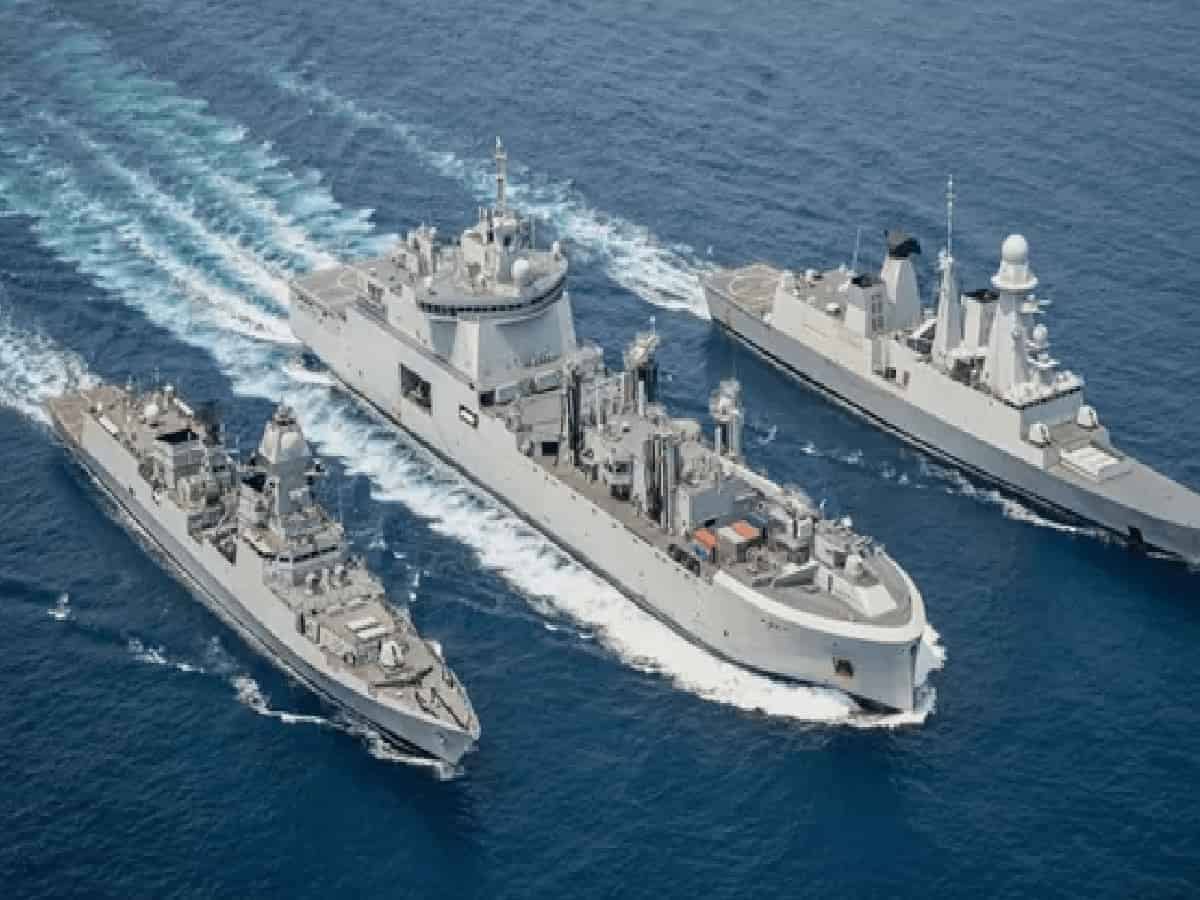

Strategic Assessment at the Indo-Pacific Regional Dialogue
Admiral Krishna Swaminathan, Chief of Naval Staff, addressed top defense strategists, international delegations, and maritime scholars at the apex-level Indo-Pacific Regional Dialogue (IPRD) in New Delhi on November 5, 2026. During his address, he delivered a comprehensive strategic assessment of emerging oceanic challenges, warning that the global maritime theater has entered an intensely competitive and friction-prone phase.
Emphasizing that modern geopolitics is being buffeted by shifting power equations, rapid technological disruptions, and clashing national interests, the Navy Chief observed that high seas and critical sea lanes of communication are not merely witnesses to this shifting international order, but sit firmly at the epicenter of global strategic friction.
Admiral Swaminathan noted that these conditions necessitate enhanced collective maritime domain awareness and deeper regional security cooperation among stakeholder nations. He argued that the current geopolitical landscape requires a unified response to maintain stability in waters that serve as the primary arteries for global commerce and strategic influence.
Operational Deliverables and Democratic Alignment
The Navy Chief urged maritime stakeholders and partner navies to translate shared democratic values and strategic interests into concrete, operational deliverables and long-term security architecture. He affirmed that dialogues like the IPRD play a catalytic role in transforming collaborative defense discussions into practical frameworks.
According to Admiral Swaminathan, these frameworks are essential to ensure uninterrupted maritime trade, protect vital sea lanes, and deter unilateral revisionism across the Indo-Pacific commons. The emphasis on operational deliverables signals a shift from purely diplomatic engagement to actionable security measures among partner nations.
The theme of IPRD 2026 centers on advancing science, technology, and academic cooperation to tackle complex undersea and surface-level challenges. The event provided a platform for discussing how technological advancements can be leveraged to address these growing maritime complexities, bridging the gap between theoretical research and practical naval application.
Geographic Specifics and Oceanic Flow
In illustrating the scale of maritime dynamics, Admiral Swaminathan noted that nature moves approximately 15 million cubic meters of water per second through the Indonesian archipelago from the Pacific Ocean into the Indian Ocean. This specific geographic reference highlighted the physical realities underpinning the strategic competition in the region.
The mention of this massive hydrological flow served to underscore the critical importance of choke points and sea lanes that are vulnerable to disruption. By grounding his strategic assessment in tangible natural phenomena, Admiral Swaminathan provided a concrete basis for understanding the volume and velocity of maritime traffic that requires protection.
Government Commitment to Open Seas
Union Defence Minister Rajnath Singh participated in a key plenary session of the dialogue, reinforcing India’s commitment to preserving free, open, and rules-based seas across vital trade corridors of the southern hemisphere. His presence at the plenary session signaled high-level governmental support for the initiatives discussed during the dialogue.
The Indian government's stance aligns with Prime Minister Narendra Modi’s Indo-Pacific Oceans Initiative (IPOI). Launched during the 14th East Asia Summit in Bangkok in November 2019, the IPOI established a seven-pillar roadmap for cooperative oceanic stewardship. Admiral Swaminathan aligned his current strategic assessment with this existing framework, emphasizing continuity in India's approach to regional maritime security.
By referencing the IPOI, the Navy Chief connected contemporary security concerns with long-standing diplomatic efforts to foster regional cooperation. The seven-pillar roadmap continues to serve as a foundational document for India’s engagement with Indo-Pacific partners, ensuring that strategic assessments are backed by established policy structures.