

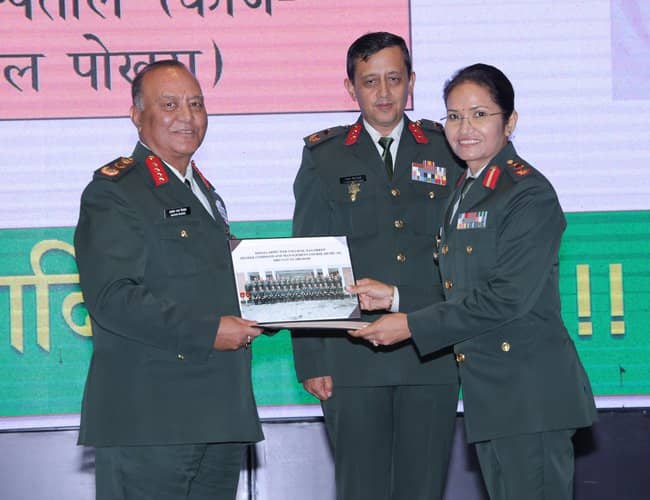

The 14th Higher Command and Management Course at the Nepalese Army War College has officially concluded. The program ran from Chaitra 15, 2082 B.S., until its final day on Shrawan 5, 2083 B.S.
A closing ceremony was held to mark the end of the session. General Ashok Raj Sigdel presided over this event in his capacity as Chief of Army Staff for the Nepalese Army. Major General Madhukar Singh Karki delivered a welcome address during the proceedings, serving as the course's Chief Instructor.
Award Ceremony and Participant Recognition
During the formal closing ceremony held on Shrawan 5, 2083 B.S., specific awards were presented to highlight individual achievements among the graduating officers. Brigadier General Prashant Bajracharya was recognized for his performance during the course.
The award citation designated him as the Best Student Officer based on outstanding overall performance throughout the duration of the training program. Major General Madhukar Singh Karki oversaw these evaluations and presented the accolades to the respective recipients at the ceremony location. In a separate category recognizing academic contributions, Brigadier General Prakash Thapa received an award for his research output.
Brigadier General Prakash Thapa was identified as the recipient of the Best Research Paper Award. This recognition reflects the emphasis placed on scholarly inquiry and strategic analysis within the curriculum structure designed by the Nepalese Army War College leadership. The ceremony also saw attendance from former Chiefs of Army Staff, senior generals currently serving in other capacities, military officers who did not participate as students this year, and family members of the graduating Brigadier Generals. Their presence underscored the institutional importance attached to the completion of this specific higher education track.
Curriculum Scope and Strategic Objectives
The Higher Command and Management Course stands designated as the highest-level professional military education program conducted by the Nepalese Army for its officers. The curriculum was designed to provide participants with advanced knowledge across a wide spectrum of strategic disciplines. According to course documentation released prior to the commencement, the syllabus covers statecraft alongside geopolitics and economic dynamics. Participants also studied political philosophy and diplomacy as core components of their training.
Additional modules focused on world order concepts and military strategy within the context of national security. The program integrated leadership development with management principles relevant to high-level command structures. The objective stated by organizers for this specific iteration was to provide participants with advanced knowledge in statecraft, geopolitics and economic dynamics, political philosophy, diplomacy, world order, military and security strategy, and leadership and management.
Historical Enrollment Statistics
The Higher Command and Management Course has been an ongoing initiative since its establishment in 2071 B.S. Historical records indicate the cumulative impact of this educational track on the officer corps over time. Since that inception date, the course has graduated a total of 410 officers. This figure represents all cohorts completed prior to and including the current session.
The current cohort consisted of thirty-five Brigadier Generals who participated in the training program during this specific cycle between Chaitra 2082 B.S. and Shrawan 2083 B.S. These officers represent a significant portion of the senior leadership pipeline for the Nepalese Army. The completion marks another milestone in the professional development history of these thirty-five individuals who have now finished their advanced studies at the War College.
General Ashok Raj Sigdel, presiding over the final ceremony, highlighted the significance of maintaining high standards within this premier training institution. The presence of former Chiefs and senior generals suggests a tradition of peer review and mentorship that continues to influence the program's direction. The Nepalese Army War College maintains these records as part of its institutional history regarding professional military education delivery.
The course structure ensures that graduates possess comprehensive knowledge in statecraft, geopolitics and economic dynamics, political philosophy, diplomacy, world order, military and security strategy, and leadership and management. This breadth of training prepares officers for complex command roles within the national defense framework. The program continues to serve as a primary vehicle for advanced professional development among Brigadier Generals serving in the Nepalese Army.