


Shifting Security Assessments in the Far North
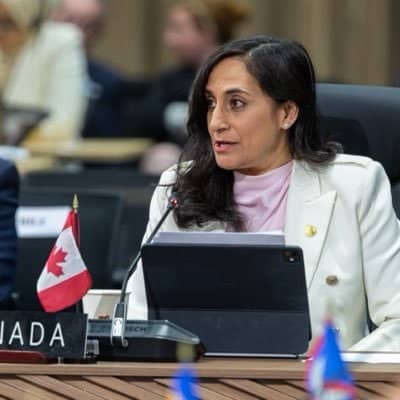
Canada has warned that security threats facing its Arctic region have "shifted significantly" as Russia’s war in Ukraine, strategic competition, and questions about sovereignty reshape the geopolitics of the far north. Foreign Affairs Minister Anita Anand stated that Canada and the United States continue to coordinate closely on Arctic security despite broader political and trade tensions between the neighboring countries.
Anand told Global News that Russia’s invasion of Ukraine changed how governments assess security in Europe and the Arctic. She attended a meeting of Arctic nations convened last week by US Secretary of State Marco Rubio. The participants "had a frank discussion about the collective need to work together on Arctic security," Anand said.
"So the United States is very much at the table in this conversation," she said. "And one of the ongoing dialogues that Secretary Rubio and I have had specifically … is in fact how can Canada and the United States ensure that our shared interests are protected." Anand emphasized that the United States is "very much at the table" regarding shared interests in multilateral organizations including NATO, signaling a continued commitment to alliance structures despite domestic political friction.
Diplomatic and Military Posture Adjustments
Canada and the United States share responsibility for monitoring and defending northern approaches to North America, though their relationship has faced strain over tariffs and political disputes. Anand called for NATO to give greater attention to threats in the north rather than concentrating primarily on eastern European members.
Prime Minister Mark Carney’s government announced plans to increase defense spending and strengthen Canada’s military presence, including a contract with German shipbuilder TKMS for up to 12 submarines. The Canadian government has not yet completed its decision on purchasing new fighter aircraft.
Ottawa is expanding its diplomatic footprint by opening a consulate in Nuuk, Greenland, and planning another in Anchorage, Alaska. A poll conducted for the Observatoire de la politique et la sécurité de l’Arctique found that 48 percent of respondents in Nunavut, the Northwest Territories, Yukon, and Nunavik regard the United States as the greatest threat to the region.
The same survey identified Russia as a threat by 30 percent of respondents and China by 12 percent. Canada and the United States remain partners in NORAD to monitor aircraft, missiles, and other threats approaching North America.
Broader Strategic Context
Arctic strategic importance is increasing as retreating ice makes shipping routes and natural resources more accessible. Russia maintains a substantial military presence in the region, while China describes itself as a "near-Arctic state" seeking a larger economic and scientific role.
India has maintained an Arctic research presence and released an Arctic policy in 2022 covering climate science, polar research, shipping routes, and effects on the Indian monsoon and Himalayan environment.