


Background and Scope of Operation
The United States Department of Justice issued a formal announcement on Tuesday, June 23, 2026, detailing the results of what officials have termed the "National Health Care Fraud Takedown." This coordinated operation represents one of the largest simultaneous actions taken against healthcare fraud networks in recent history. The investigation was executed by federal agents from the Federal Bureau of Investigation (FBI) working in conjunction with prosecutors across various divisions within the Justice Department.
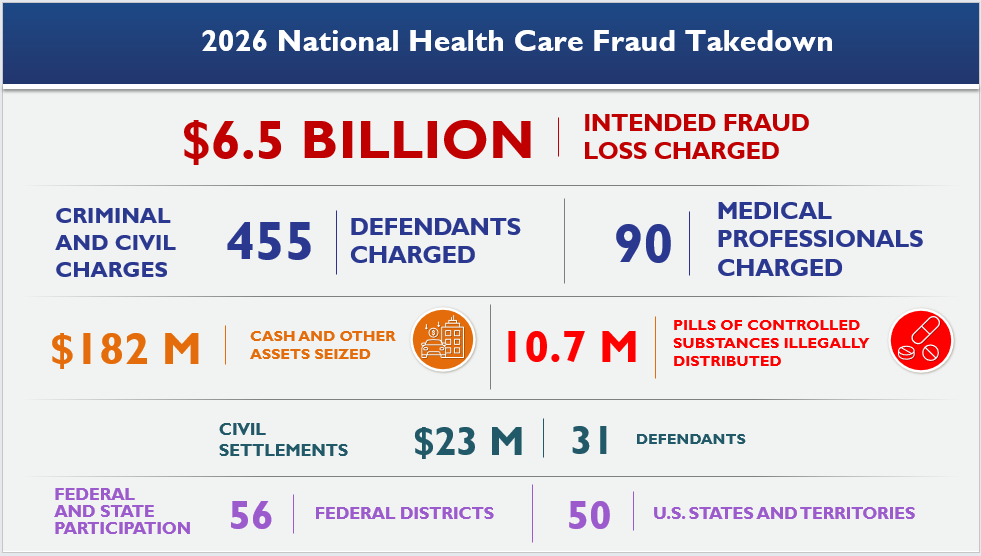
The scale of the alleged scheme is substantial, involving financial losses estimated at over $6.5 billion for American taxpayers and healthcare providers. To execute such a complex operation, investigators utilized resources spanning 56 federal districts located throughout all 45 states in the United States. The scope extended beyond domestic borders, incorporating international cooperation with law enforcement agencies to track assets and individuals involved in cross-border financial transactions related to the fraud.
Healthcare fraud is defined by prosecutors as a white-collar crime that often involves billing for services not rendered, inflating prices for medical procedures, or submitting claims using false patient information. In this specific case, the alleged network operated with enough sophistication and coordination to evade detection until federal agents could mobilize resources across multiple jurisdictions simultaneously.
Details of Charges and Seized Assets
The charges announced on Tuesday encompass a wide array of criminal offenses related to healthcare fraud. Among those charged are at least 90 doctors, nurses, and other licensed medical professionals who allegedly participated in the scheme by submitting fraudulent claims or falsifying patient records. These individuals faced felony counts that carry significant potential prison sentences upon conviction.
In addition to individual practitioners, the charges extend to a range of non-clinical roles within healthcare organizations. This includes billing specialists, administrative staff, and executives who allegedly facilitated the submission of false insurance claims or managed accounts designed specifically for fraudulent activity. The indictment details suggest that these individuals acted in concert with one another, creating an interconnected web of deception that exploited gaps between different payers, including Medicare, Medicaid, private insurers, and self-pay patients.
A critical component of this operation was the seizure of assets directly linked to the alleged fraud. Federal agents confiscated property totaling $182 million during the course of the investigation. These seized items included real estate properties, bank accounts containing illicit funds, vehicles used by suspects, and various financial instruments that had been utilized to launder money derived from fraudulent billing practices.
The seizure operations were conducted simultaneously in multiple locations across the country, demonstrating the logistical complexity required for such a takedown. By freezing these assets immediately upon arrest or indictment, authorities aimed to prevent defendants from dissipating funds prior to trial and to recover losses suffered by victims of the fraud scheme.
Regional Implications and Specific Cases
The investigation's reach was particularly notable in specific regions where healthcare systems are highly concentrated. Notably, three individuals based in Utah faced charges specifically related to alleged Medicaid fraud as part of this broader national operation. This highlights the fact that while the scheme had a nationwide footprint, certain geographic clusters were identified as hotspots for particular types of fraudulent activity.
Medicaid fraud involves submitting false claims to government-funded programs intended for low-income individuals and families. The involvement of Utah-based suspects suggests that regional variations in billing practices or oversight mechanisms may have been exploited by the organizers of this scheme. Federal prosecutors indicated that these specific charges were part of a larger pattern observed across different states, where similar tactics were employed against various payers.
The announcement also included details about other regions affected by the takedown, though names and locations for all 455 individuals have not been fully disclosed in public summaries to protect ongoing investigations or ensure fair trial rights. However, reports indicate that major metropolitan areas with large hospital networks were significant focal points of the probe.
Legal experts note that charging such a high number of individuals simultaneously is rare and typically reserved for cases involving massive financial losses or organized criminal enterprises. The decision to charge 455 people at once underscores the Department of Justice's commitment to dismantling large-scale fraud networks rather than pursuing isolated incidents individually.
The timing of the announcement, occurring on June 23, 2026, coincides with heightened scrutiny from Congress and state legislatures regarding healthcare costs and integrity. Officials stated that this operation serves as a warning to those attempting to exploit gaps in federal health insurance programs for personal or organizational gain.
Following the announcement, law enforcement agencies emphasized their continued commitment to investigating similar cases and recovering additional funds lost through fraud. The Justice Department reiterated its stance that healthcare providers have an ethical obligation not only to follow billing regulations but also to report suspicious activities within their own organizations when they become aware of potential fraudulent schemes.