

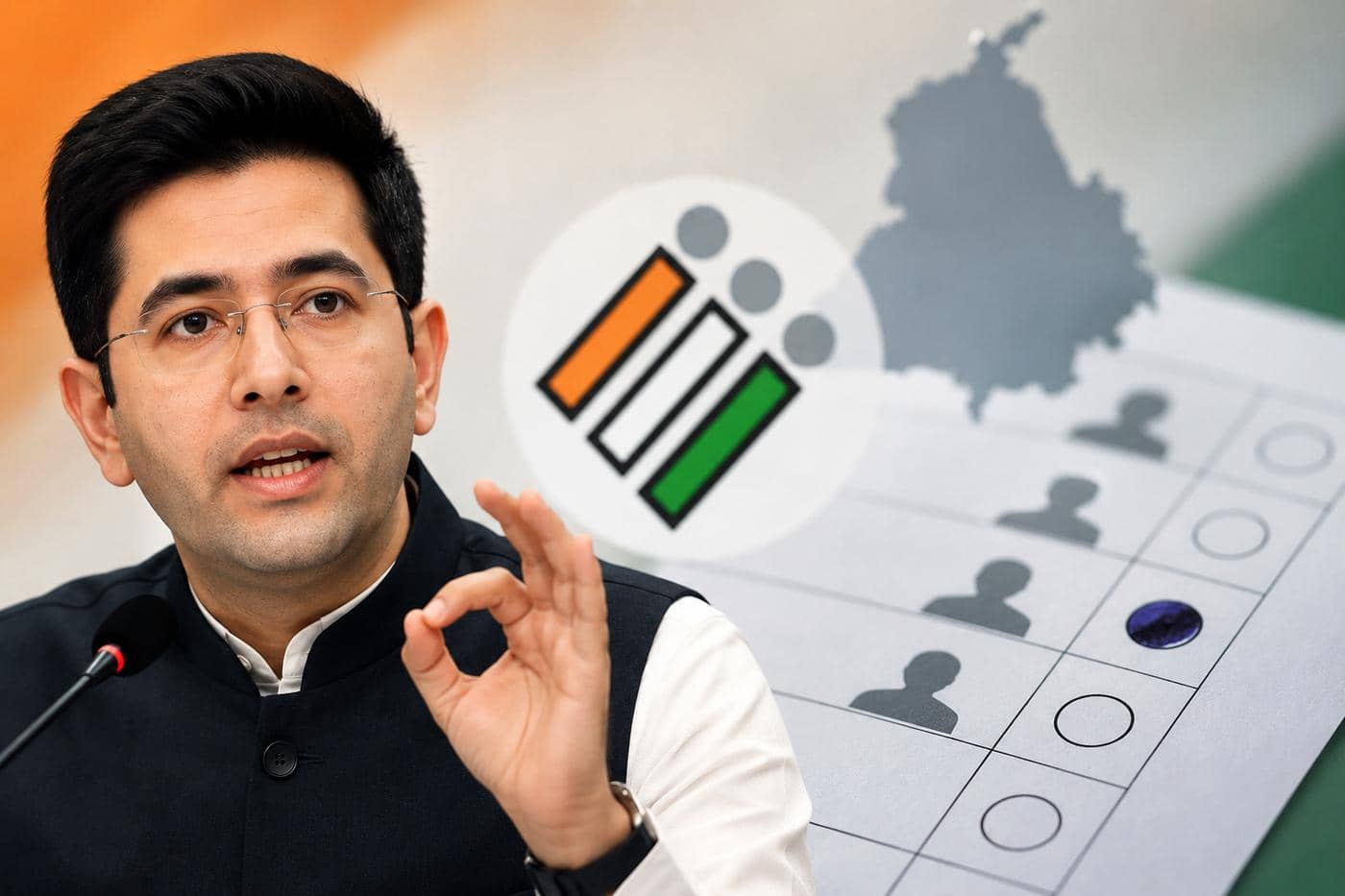

Allegations of Political Vendetta in Voter Roll Revision
Bharatiya Janata Party (BJP) Rajya Sabha MP Raghav Chadha has leveled serious accusations against the Aam Aadmi Party (AAP) government in Punjab, alleging political revenge in connection with recent alterations to the state's draft voter rolls. The core of the controversy revolves around a specific entry in the electoral documents where Chadha’s name was conspicuously marked as "permanently shifted." This designation, typically applied to individuals who have moved their permanent residence out of a constituency, has sparked immediate outrage from the opposition, who interpret the administrative action as a deliberate act of retaliation.
According to reports from the GG News Bureau in Chandigarh, the marking of Chadha's name has not only drawn attention to the individual case but also ignited a broader debate about the integrity of the electoral process in Punjab. Chadha, a prominent national figure within the BJP, unequivocally characterized the incident as a "political vendetta." His accusation suggests a calculated misuse of administrative authority by the ruling AAP in Punjab, aiming to target political adversaries through the sensitive and critical electoral registration system. Such an action, if proven, would represent a significant breach of democratic norms and raise questions about the fairness and impartiality of voter list modifications.
The significance of a Rajya Sabha MP's name being marked as 'permanently shifted' is particularly notable. While ordinary citizens might face such administrative changes due to relocation, for an active politician, especially one from an opposing party, it can be perceived as an attempt to disenfranchise or inconvenience them, potentially impacting their ability to vote in their designated constituency. This incident underscores the heightened political tensions between the BJP and the AAP, with the opposition demanding greater transparency and accountability in the management of voter records.
The Electoral Commission's Role in Voter List Updates
Special Summary Revision Process Explained
In response to the grave allegations, representatives of the Aam Aadmi Party have moved to clarify the state government's position, asserting that the Punjab administration has no direct involvement in the Special Summary Revision (SSR) process. The SSR is a crucial, periodic exercise meticulously conducted by the Election Commission of India (ECI) to ensure the electoral rolls are accurate, updated, and comprehensive. This process involves adding new eligible voters, deleting names of deceased or permanently shifted electors, and correcting any errors, thereby maintaining the sanctity of the democratic process.
AAP officials emphasized that the entire procedure for updating electoral rolls, including the SSR, falls squarely within the jurisdiction of the independent election authorities, not the state ministry. This defense aims to unequivocally distance the state administration from any specific administrative decisions made by the election machinery, particularly those pertaining to individual voter entries. By highlighting the constitutional separation between state governance and the autonomous electoral body, AAP officials are attempting to deflect accusations of political manipulation and underscore the procedural independence of the voter registration system.
The Election Commission of India is a constitutional body responsible for administering elections in India. Its mandate includes the preparation and revision of electoral rolls, ensuring free and fair elections. The SSR process is a key component of this mandate, involving a detailed schedule for draft publication, inviting claims and objections from the public, and finally, the publication of the final electoral roll. This multi-stage process is designed to be transparent and allow for public scrutiny and participation, acting as a safeguard against arbitrary changes.
Final Electoral Roll Publication Nears
The ongoing dispute over the draft voter rolls is set against a clearly defined timeline established by the Election Commission of India. The culmination of the current revision cycle is fast approaching, with the final electoral roll for Punjab officially scheduled to be released on October 1. This date is not merely a procedural deadline but a critical juncture for all stakeholders, marking the point after which the electoral lists will be finalized and used for upcoming elections, barring any subsequent special revisions.
The impending release of the final roll holds significant implications for both the political parties embroiled in this controversy. For the BJP, it represents the final opportunity to meticulously scrutinize the updated data and formally challenge any remaining discrepancies or perceived biases that they believe could compromise the fairness of future electoral outcomes. Conversely, for the AAP government, the October 1 milestone serves as an important moment to demonstrate its commitment to electoral regulations and transparency, especially in the face of persistent allegations of interference. The accuracy and integrity of these final rolls are paramount for maintaining public confidence in Punjab's democratic framework.
Scrutinizing Electoral Integrity in Punjab
The incident involving Raghav Chadha’s name being marked as permanently shifted has brought into sharp focus the broader mechanisms and vulnerabilities of voter registration in Punjab. As the October 1 deadline for the final electoral roll approaches, both the ruling and opposition parties are expected to intensify their scrutiny of the draft rolls, searching for any other anomalies or irregularities that could potentially influence future electoral dynamics and outcomes in the state.
The stark divergence in narratives—the BJP’s firm characterization of the event as politically motivated revenge contrasting sharply with the AAP’s assertion of complete non-involvement by the state government—underscores the complex interplay between state-level politics and the national electoral frameworks in India. This particular dispute highlights how administrative actions, even those seemingly minor, can quickly escalate into major political flashpoints, especially when trust between political rivals is low. The finalization of the Punjab electoral roll on October 1 will ultimately provide a definitive, official record that both parties, despite their current disagreements over the draft version, will be bound to accept as the basis for the state's electorate.