Full story
BJP Condemns Gandhi’s Criticism of Modi Over Trilateral Meeting
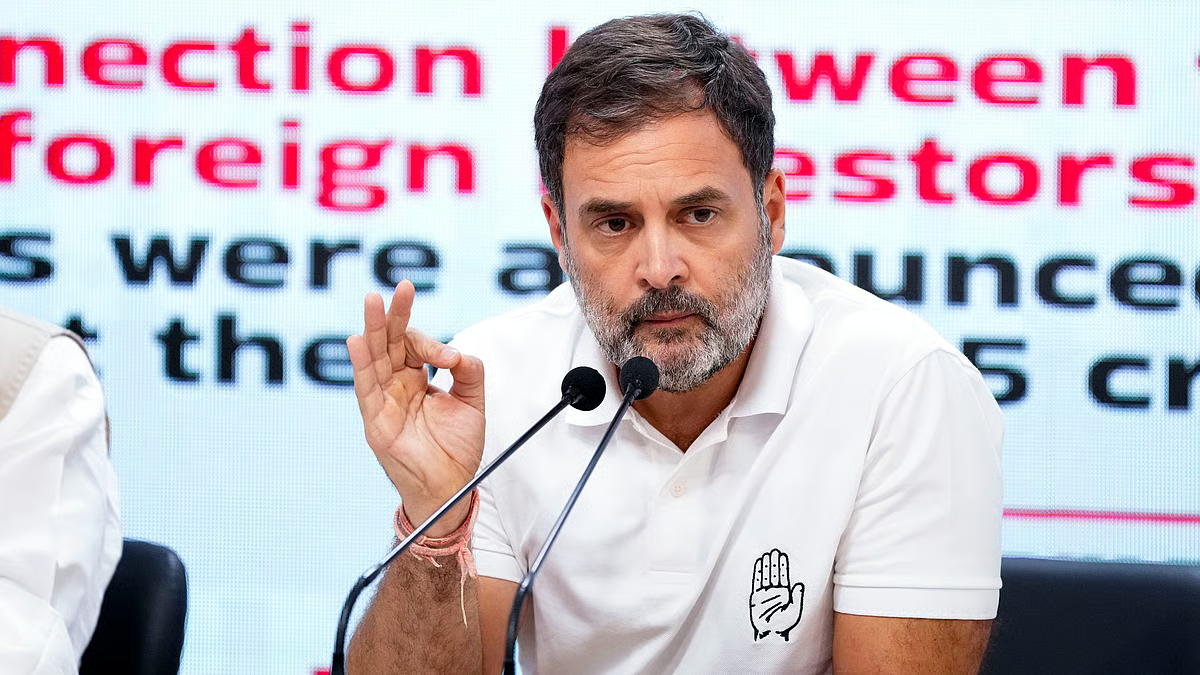
The Bharatiya Janata Party (BJP) launched a sharp critique of Rahul Gandhi on Friday following his remarks concerning Prime Minister Narendra Modi and the recent trilateral meeting involving United States President Donald Trump, Chinese President Xi Jinping, and Russian President Vladimir Putin. BJP leaders described Gandhi as "clueless on geopolitics" and alleged that he was advancing "pro-Pakistan propaganda" through his criticisms.
Union Parliamentary Affairs Minister Kiren Rijiju addressed the controversy in statements to the Press Trust of India (PTI), asserting that Gandhi should refrain from making statements against India, regardless of whether such comments are made within the country or abroad. Rijiju’s remarks underscored the party’s stance that Gandhi’s observations on international diplomacy were inappropriate.
The backlash intensified after BJP national spokesperson Gaurav Bhatia circulated an artificial intelligence-generated image on the social media platform X. The image depicted Gandhi serving drinks to Donald Trump at the meeting involving Putin and Xi Jinping, accompanied by the caption "Kuch aise (Something like this)." The post was intended to mock Gandhi’s perspective on the diplomatic gathering.
BJP leader C R Kesavan echoed the criticism, stating that Gandhi was "utterly clueless" about global geopolitics. Kesavan further accused Gandhi of acting as a "leader of pro-Pakistan propaganda," linking his comments to broader accusations regarding his political alignment and understanding of international relations.
Defense of India’s Diplomatic Strategy and Historical Context
In response to the criticism, BJP national spokesperson Ashish Usha Agarwal argued that a three-way meeting involving the United States, China, and Russia does not determine India’s place in the world. Agarwal noted that New Delhi engages with rival powers through multiple multilateral frameworks, including BRICS, the Quad, the Shanghai Cooperation Organisation (SCO), the G20, and the G7.
Agarwal highlighted India’s specific diplomatic achievements to illustrate the country’s independent foreign policy trajectory. These milestones included India’s entry into the Missile Technology Control Regime (MTCR) in 2016, joining the Wassenaar Arrangement in 2017, becoming a member of the Australia Group in 2018, and gaining full membership in the Shanghai Cooperation Organisation (SCO) in 2017.
Agarwal questioned why Sonia Gandhi met foreign heads of state when Manmohan Singh was prime minister, asserting that "India's global standing is built on strategic autonomy, national interest and institutional strength -- not dynastic privilege or photo opportunities." He added that Rahul Gandhi should stop confusing a photograph with foreign policy and that Congress must answer for its own record before lecturing India.
Clarification on International Groupings and APEC
BJP social media national convenor Deepak Mhaskey posted on X that not every international grouping revolves around India and that a little understanding of diplomacy would help. Mhaskey stated that the Asia-Pacific Economic Cooperation (APEC) was established in November 1989 when Rajiv Gandhi was prime minister.
Mhaskey explained that APEC is a forum for economies bordering the Pacific, and since India does not border the Pacific, questions about its absence are nonsensical. He added that every grouping has its own purpose, membership, and strategic priorities as part of international diplomacy.