


Summit Deadlock Persists in Kathmandu
\n\nLongest Hiatus in Organization History
\nThe South Asian Association for Regional Cooperation (SAARC) has not held a summit since November 2014, marking the longest period of inactivity for the intergovernmental organization. The 18th SAARC summit took place in Nepal during that month, after which no subsequent gatherings of member heads of state have occurred.
\nThe failure to convene the scheduled 19th summit was triggered by diplomatic tensions in November 2016. India and several other member states withdrew from the proceedings following an attack by a Pakistani militant group at the Uri military base. The summit, which had been scheduled to take place in Pakistan, was indefinitely postponed as a result of these withdrawals.
\nThe organization remains headquartered in Kathmandu, Nepal. Golam Sarwar serves as the Secretary-General, with Bangladesh currently holding the chairmanship of the body.
\n\nEconomic Potential vs. Political Reality
\n\nDemographics and Market Size Unutilized
\nDespite the political stagnation, the demographic and economic indicators for the region remain substantial. As of 2026, the combined population of SAARC member states is estimated at 2,106,270,434 people. The region's gross domestic product measured by purchasing power parity stands at $23.3 trillion, with a nominal GDP of $5.30 trillion.
\nH. M. G. S. Palihakkara, delivering the inaugural SAU-RCSS lecture at the Regional Centre for Strategic Studies in Colombo on October 26, 2026, highlighted the disparity between South Asia's potential and its actual performance. He noted that the region possesses the markets, people, and geography necessary to become a thriving economic space.
\nPalihakkara pointed out that South Asia is one of the world’s most densely populated regions, featuring enormous markets and young populations with a median age of 27.8 years. The area includes rapidly growing economies, extraordinary cultural connections, and some of the world’s busiest trading routes. Member countries share borders, economic spaces, and access to the Indian Ocean.
\n\nNormalization of Non-Cooperation
\nHowever, Palihakkara argued that political rivalry, mistrust, and protectionism continue to prevent member states from turning their proximity into prosperity. He stated that the region has gradually but inevitably normalized non-cooperation.
\nThis dynamic creates what Palihakkara described as a \"peculiar paradox.\" While the countries share physical borders and economic spaces, they behave economically as though they are separated by unforgiving chasms and oceans. The numbers regarding regional trade and integration reflect this dispiriting story of regressive cooperation.
\n\nOrganizational Structure and Observers
\n\nMembership Composition
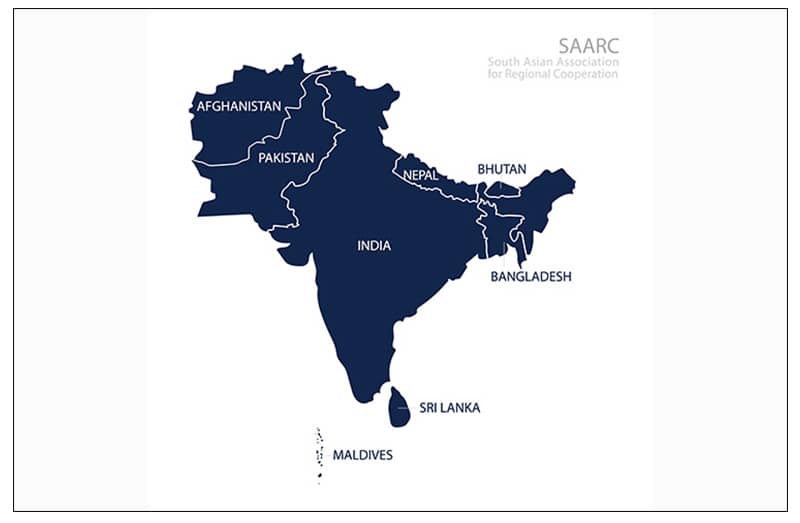
\nSAARC is an intergovernmental organization comprising eight sovereign states: Afghanistan, Bangladesh, Bhutan, India, Maldives, Nepal, Pakistan, and Sri Lanka. The organization was founded in Dhaka, Bangladesh, on December 8, 1985.
\nIn addition to the member states, SAARC includes nine non-member observers. These entities are Australia, China, the European Union, Iran,