


Trump Brings Campaign Rally to Choctaw Sovereign Territory
President Donald Trump is scheduled to hold a campaign rally on the Choctaw Nation of Oklahoma this Thursday, marking another instance in a rare historical trend of sitting U.S. presidents visiting tribal nations while in office. The event is part of Trump’s broader campaign strategy, which has focused heavily on pushing through deep red states to stump for Republican candidates and promote his political agenda ahead of November’s midterm elections.
While the rally represents a significant logistical and political moment for the current administration, the relationship between the federal government and the Choctaw Nation regarding this specific event is defined by clear boundaries. According to Choctaw Nation Principal Chief Gary Batton, the tribe is renting its venue for the rally but is not sponsoring the event. Batton stated that the nation hopes the visit provides an opportunity for the president and his team to learn about their sovereign nation, rather than treating the land merely as a political backdrop.
Despite the high-profile nature of the visit, it was not immediately clear why Trump picked this specific location for his rally. The decision adds to the complexity of presidential engagements with Indigenous communities, where historical precedents range from diplomatic recognition to forced assimilation and displacement.
A History of Presidential Visits: From Recognition to Dismantling
Presidential visits to reservations have been rare since tribal delegations began meeting with presidents in Washington during the Early Republic. When they do occur, the context varies drastically depending on the era and the administration’s policy toward Indigenous sovereignty.
In a more recent example of engagement, Trump visited the Lumbee Tribe of North Carolina in 2020. During that visit, he endorsed their push for federal recognition, a status he later signed into law in 2025. This action stands in contrast to earlier historical interactions where presidential visits were tied to policies aimed at dismantling tribal structures.
One of the earliest recorded instances of a president visiting tribal land occurred in 1883, when President Chester A. Arthur met with Shoshone and Arapaho leaders on the Wind River Reservation. During this meeting, his delegation attempted to persuade chiefs to break up their reservation into private parcels. This move was widely understood as an effort aimed at dismantling tribal sovereignty by eroding the communal land base that supported it.
The resistance to such policies is evident in historical records. Both Shoshone Chief Washakie and Arapaho Chief Black Coal refused to consent to breaking up their shared reservation, maintaining their community’s integrity despite federal pressure. This refusal highlights a long-standing tension between presidential initiatives and tribal self-determination.
Assimilation, Removal, and the Path to Modern Engagement
The 20th century saw presidential visits often linked to assimilationist policies or forced removals. In 1903, Theodore Roosevelt’s visit to Havasupai land preceded the forced removal of that tribe to make way for a national park. Similarly, during his 1927 visit to the Pine Ridge Reservation in South Dakota, President Calvin Coolidge promoted assimilationist boarding schools, reinforcing federal efforts to erase Indigenous cultural practices.
A shift toward acknowledgment and investment began in the late 20th century. President Bill Clinton made Pine Ridge a stop on his 1999 “New Markets Tour.” Clinton’s visit was notable for being the first by a sitting president to tribal land since Franklin Delano Roosevelt’s 1934 trip to the Blackfeet Nation in Montana. During his time in Pine Ridge, Clinton acknowledged that the federal government had failed to meet its obligations to hundreds of tribal nations and called for increased investment in the region’s economy.
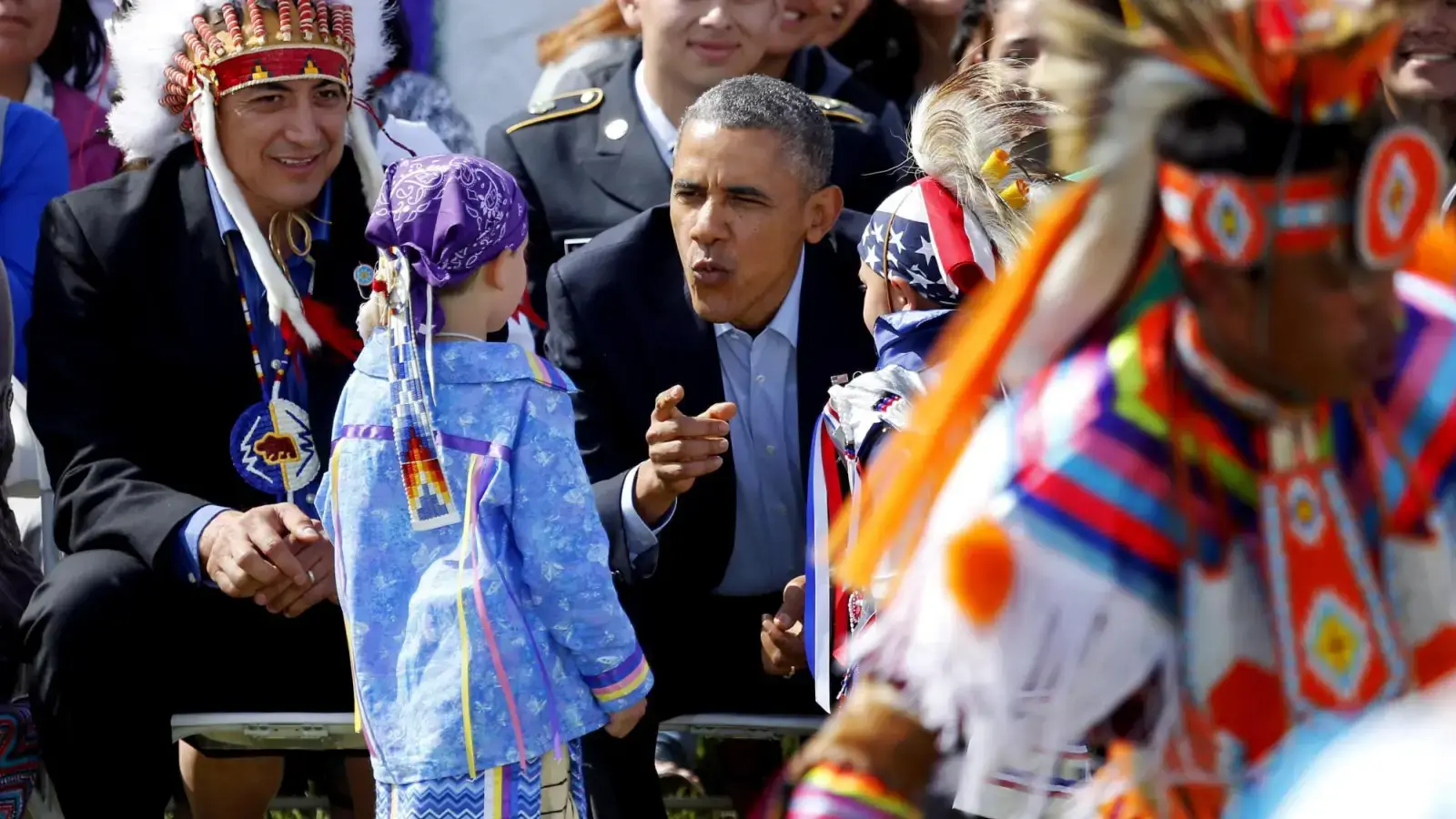
This trend of engagement continued under subsequent administrations. In 2014, President Barack Obama met with Dakota youths and attended a powwow on the Standing Rock Reservation in North Dakota. His visit focused on expanding economic and educational opportunities and promoting tribes’ inherent right to govern themselves, signaling a departure from the earlier eras of forced assimilation or land seizure.
As Trump prepares for his upcoming rally in Oklahoma, the event sits within this complex lineage of presidential interactions with Indigenous peoples. While the Choctaw Nation has clarified its non-sponsoring role in the political event, the visit continues a pattern of rare but significant federal attention to tribal lands, whether driven by political strategy, historical recognition, or policy shifts.