

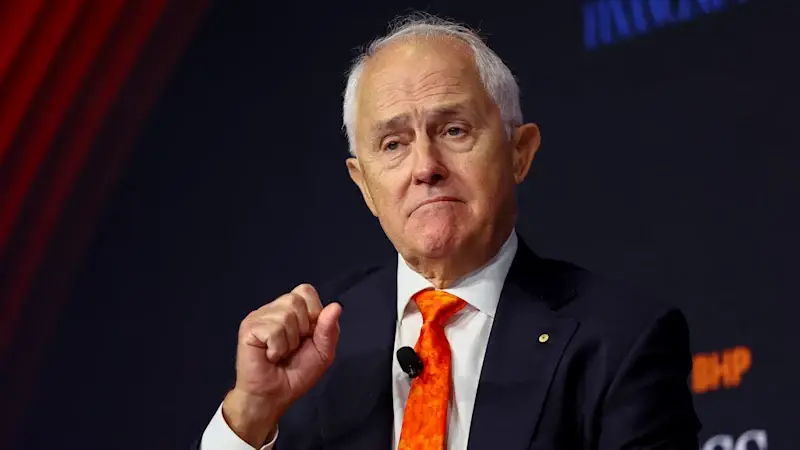

Turnbull Condemns Coalition’s Stance on EU Trade Pact
Former Liberal prime minister Malcolm Turnbull has issued a sharp rebuke of the Coalition’s current position on trade policy, describing the party’s opposition to a European Union free trade agreement as "crazy" and a "terrible mistake." The comments mark a significant public divergence between the former leader and his successors, highlighting deepening fractures within the conservative bloc over Australia’s international economic strategy.
Speaking at a function hosted by the Australian consulate in Manhattan, Turnbull did not mince words regarding the strategic implications of the Coalition’s stance. His remarks, delivered during an interview in New York, underscored his long-held belief that Australia must aggressively pursue its own national interests on the global stage, particularly as the geopolitical landscape shifts away from the multilateral frameworks that characterized much of the late 20th and early 21st centuries.
A Skeptical View of American Multilateralism
Central to Turnbull’s argument is a profound skepticism regarding the future reliability of the United States as a partner in global trade agreements. He explicitly cited the presidency of Donald Trump as a turning point, suggesting that the era of US leadership in multilateral institutions and free trade pacts may be over.
"It was vital for Australia to build partnerships with countries other than the US because he is skeptical that US leaders will return to multilateralism after Donald Trump’s presidency," Turnbull stated. This assessment forms the bedrock of his advocacy for diversifying Australia’s trade relationships. Rather than relying on a trans-Pacific alliance that may no longer be viable, Turnbull argues that Canberra must look westward and northward to secure its economic future.
This perspective is not merely theoretical for Turnbull. He noted that the negotiation for the EU free trade agreement actually commenced under his own Coalition government. The fact that the current leadership of the party he once led now opposes the finalization of a deal initiated by his administration adds a layer of political irony to his criticism. For Turnbull, the opposition is not just a policy disagreement; it is a rejection of a strategic initiative that was already underway.
Advocating for Aggressive Self-Interest
In his New York interview, Turnbull outlined a clear philosophy for Australia’s foreign policy: pursue self-interest with the same rigor that other major powers apply to their own. He pointed to the actions of Donald Trump as a model of pragmatic nationalism, albeit one that Australia should emulate for its own benefit rather than follow in spirit.
"Turnbull stated in a New York interview that Australia should pursue its own self-interest as rigorously as Trump pursues America’s and seek leverage to gain more influence over global affairs," the reports indicate. This approach suggests a move away from idealistic diplomacy toward a more transactional, power-based international relations model. By securing trade deals with major economic blocs like the EU, Australia can increase its geopolitical weight and ensure it is not left behind in a fragmented global economy.
Turnbull’s argument rests on the premise that Australia is uniquely positioned to benefit from such agreements. He highlighted the country’s existing economic openness, noting that Australia already maintains low barriers to trade and low tariffs. Furthermore, he pointed out that there are very few barriers to foreign investment within the Australian market. These factors, he argued, make Australia an attractive partner for any trading bloc.
The Case for More Free Trade Deals
Given these structural advantages, Turnbull contended that it is in Australia’s direct interest to negotiate as many free trade deals as possible. The logic is straightforward: if a country has little to fear from open markets and much to gain from access to new consumers, then restricting trade agreements is counterproductive.
The Coalition’s current opposition to the EU deal stands in stark contrast to this utilitarian view. By blocking or delaying the agreement, Turnbull suggests that the party is not only making a "terrible mistake" but also failing to leverage Australia’s competitive advantages. In a world where trade wars and protectionism are rising, particularly under the shadow of Trump’s legacy, Turnbull sees multilateral engagement with the EU as a crucial hedge against uncertainty.
The venue of his comments—the Australian consulate in Manhattan—further emphasized the international dimension of his critique. By speaking in New York, a global financial hub, Turnbull framed the issue not just as an internal Australian political dispute, but as a matter of national economic survival in a changing world order. His call to action is for Australia to stop looking inward or solely toward Washington, and instead to actively construct a network of alliances that can withstand the volatility of American politics.
As the debate over the EU trade agreement continues, Turnbull’s intervention serves as a reminder of the strategic vision that defined his tenure. Whether the Coalition will heed his warning remains to be seen, but his characterization of their stance as "crazy" leaves little doubt about where he stands on the issue.