

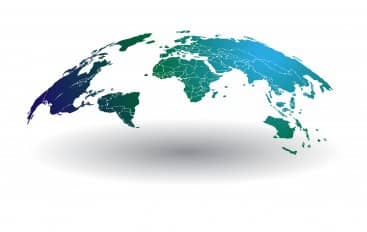

UN General Assembly Votes to Shift Cartographic Standards
The United Nations General Assembly voted 164 to 1 on September 4 to encourage moving away from the Mercator projection toward maps that more accurately represent the relative size of continents. The initiative aims to correct the distortion where Africa appears smaller than it is; in reality, Africa is about fourteen times larger than Greenland, which looks nearly the same size on old Mercator maps.
Under new maps, countries near the poles such as Canada, Russia, and Greenland will shrink, while Africa grows and India gets more room. The change affects only paper representations; no country has lost or gained actual territory.
The Geometry of Distortion
The UN argues that maps shape perceptions and collective understanding, potentially influencing how the world is imagined. However, the organization also reminds us that no flat map can represent the spherical Earth without distortion, as every projection must sacrifice area, shape, distance, or direction.
Cartography Versus Geopolitical Reality
A "map of power" measures size by GDP, military strength, technology, population, natural resources, financial influence, diplomatic reach, control over supply chains, and the ability to shape the global conversation. On this map of power, Greenland's reduction in cartographic size will not disturb Washington, and Africa's enlargement will not automatically increase its voice.
No cartographic projection will persuade a great power to surrender an interest simply because the continent on which that interest lies now looks more accurately proportioned. Countries speak about a rules-based international order but are selective about which rules they find convenient, with national interest acquiring an "almost universal exemption clause." Industry leaders at the IEEMA Annual Convention 2026 in Mumbai said the next stage of international expansion will require Indian manufacturers to identify specific customer problems. This perspective highlights how different sectors interpret global shifts, whether they relate to trade dynamics or cartographic accuracy.