


Pentagon Plans Independent Base Operations During Grid Failure
The Department of Defense is preparing for a scenario in which the American power grid collapses, supply chains halt, and military installations must operate for three months without outside support, according to Fox News. Pentagon planners have branded this unpublicized plan FORTRESS, aiming to make major bases across the continental United States capable of functioning independently for at least 90 days.
DoD spokesperson Sean Parnell stated, "We don't want to rely on standard civilian municipal infrastructure to run our national defense. We just simply can't. It's an intolerable risk." The Pentagon is exploring portable nuclear reactors, massive battery installations, and independent microgrids that would allow bases to disconnect from civilian power systems during prolonged blackouts.
Officials have long feared that the loss of electricity could cripple communications, logistics, weapons production, and military command structures. To mitigate these vulnerabilities, the FORTRESS plan reportedly calls for stockpiling ammunition, fuel, critical minerals, electronics, spare parts, and medical supplies. Additionally, the strategy includes preparing civilian factories to transition into wartime production capabilities.
The scope of this preparation extends beyond immediate power generation. The Pentagon plans recurring industrial stress tests and mobilization exercises to ensure readiness. These measures also aim to protect communications and navigation systems from satellite disruptions and GPS jamming, which are cited as potential threats during such a crisis.
Shifting Strategic Assumptions and Threat Landscape
Parnell noted that traditional defense doctrines may no longer suffice in the current geopolitical environment. "I realized that a lot of the way we think about homeland defense was built around the antiquated assumption that two oceans would protect us," he stated. He added that President Trump has paved the way for new thinking, including the Golden Dome initiative and a focus on the Western Hemisphere, Greenland, and Panama.
Emphasizing the urgency of proactive planning, Parnell stated, "The next conflict will likely be fought on multiple fronts... global supply chains will break," highlighting the need to have plans in place rather than making decisions during a conflict. This strategic shift is driven by identified threats to America's power grid from both foreign adversaries and domestic saboteurs.
Specific concerns include cyber threats from state-sponsored actors. In February 2024, the NSA and other federal agencies warned that Chinese state-sponsored hackers linked to Volt Typhoon had compromised critical U.S. infrastructure networks, including energy, water, transportation, and communications systems. Physical vulnerabilities have also been demonstrated; in December 2022, gunmen attacked two electrical substations in North Carolina, plunging roughly 45,000 customers into darkness for five days.
Logistics of Portable Power Solutions
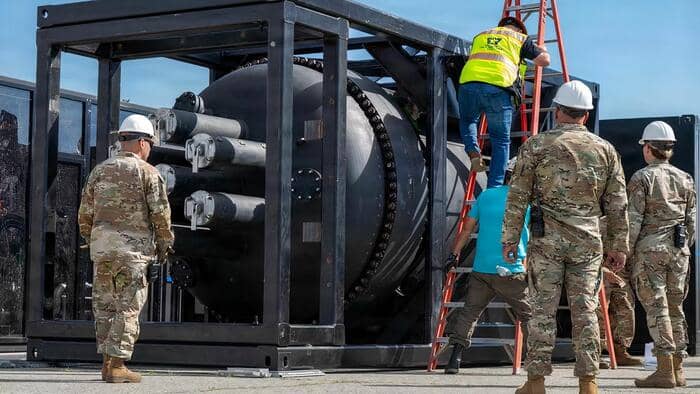
The implementation of the FORTRESS plan involves significant logistical operations to deploy advanced power sources. A photo shows U.S. Air Force airmen and civilian contractors preparing a containerized nuclear power reactor for airlift aboard a C-17 Globemaster III at March Air Reserve Base, California, on Feb. 13, 2026. This imagery underscores the scale of equipment required to sustain military installations during prolonged grid failures.
By integrating these portable energy solutions with independent microgrids and extensive stockpiles, the Department of Defense aims to ensure that national defense capabilities remain operational even in a worst-case "doomsday" scenario where civilian infrastructure fails completely.