

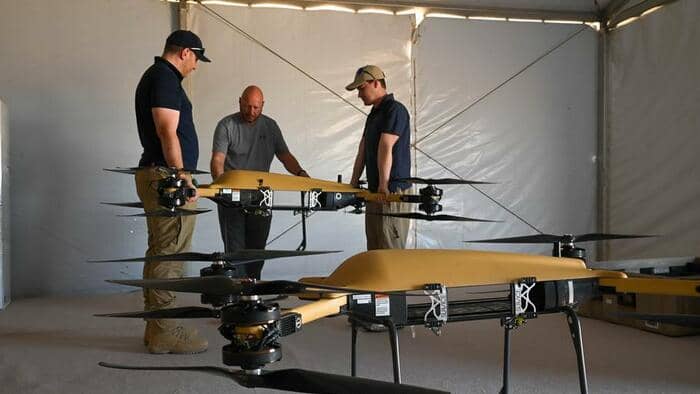

Pentagon Unveils First Multinational Attack Drone Initiative
The United States military has formally established its first multi-domain, multinational attack drone task force, marking a significant structural shift in how American forces plan to deploy unmanned systems in conjunction with allied nations. The initiative, designated Force Falcon Strike, was unveiled by US Central Command on Thursday as part of a broader strategy to integrate regional partner capabilities with existing US military operations.
Expanding the Scope of Unmanned Warfare
According to the announcement, Force Falcon Strike will employ one-way attack drones that operate across multiple environmental domains. These unmanned systems are designed to function above, on, and below the sea, representing a comprehensive approach to modern naval and aerial warfare. The task force will be operated by military support staff drawn from both the United States and regional partners, emphasizing a collaborative operational model from its inception. The strategic command center for Force Falcon Strike is scheduled to be MacDill Air Force Base in Tampa, Florida, a key hub for US Central Command operations.
Adm. Brad Cooper, the commander of US Central Command, described the new unit as an expansion of successful existing operations. "Task Force Falcon Strike will expand on Scorpion Strike’s success given the tremendous innovation happening among our regional allies and partners," Cooper stated. He further noted that integrating and deploying these new capabilities together with allied forces would help rapidly realize new operational possibilities, underscoring the strategic importance of multinational cooperation in advanced military technologies.
Integration With Existing Middle East Operations
The creation of Force Falcon Strike builds upon the framework of Task Force Scorpion Strike, an existing Pentagon deployment that has been actively utilizing one-way attack drones in the context of ongoing Middle East operations. Task Force Scorpion Strike has provided valuable insights into the effective deployment and tactical advantages of unmanned systems in contested environments. The new multinational unit, Force Falcon Strike, aims to scale and coordinate these efforts with a wider network of regional governments and military entities, leveraging proven methodologies while expanding their reach and impact.
Formalizing Allied Drone Cooperation
The broader initiative is designed to invite regional partners to coordinate and cooperate directly with Pentagon operations. This structure implies a formalized mechanism for allied nations to contribute unmanned assets and support staff to US-led missions, moving beyond ad-hoc cooperation toward a standardized multinational force structure. This level of integration is expected to enhance interoperability, share intelligence, and distribute the operational burden across multiple nations, fostering a more robust and resilient defense posture in critical regions.
By establishing a dedicated multinational task force, the United States seeks to streamline the deployment of advanced drone technologies, ensuring that regional allies are not merely recipients of US support but active contributors to joint security objectives. This collaborative model is intended to unlock new operational possibilities that would be difficult to achieve through unilateral action, particularly in the complex and evolving landscape of modern warfare.
Ukraine Conflict Shapes New Drone Tactics
Reports indicate that the development of tactics and battle plans for this new drone unit are significantly influenced by lessons learned from the ongoing conflict in Ukraine. The Pentagon has been meticulously analyzing the strategies employed by both Ukrainian and Russian forces during their years-long war, particularly focusing on the pervasive and decisive role of unmanned aerial systems, to inform its own approach to unmanned warfare.
Adapting to Modern Battlefield Realities
The conflict in Ukraine has demonstrated the critical importance of readily available, cost-effective, and adaptable drone technologies for reconnaissance, targeting, and direct engagement. Analysis suggests that while the US is developing comprehensive drone swarm battle plans, the process has occurred later in the timeline compared to the immediate tactical adaptations seen in Eastern Europe. Despite this timing, the Pentagon identifies the integration of drone swarms and one-way attack systems as a clear and imperative direction for future conflict spaces, acknowledging their transformative impact on battlefield dynamics.
The focus on one-way attack drones reflects a strategic shift toward expendable unmanned systems that do not return to base after completing their missions. This approach allows for higher risk tolerance and more aggressive deployment patterns in contested environments, a tactic increasingly observed in modern asymmetric warfare scenarios where the cost-effectiveness and sheer volume of drones can overwhelm traditional defenses. The experience in Ukraine has highlighted how such systems can provide persistent surveillance, precision strike capabilities, and even act as decoys or suppress enemy air defenses, fundamentally altering the calculus of engagement.