

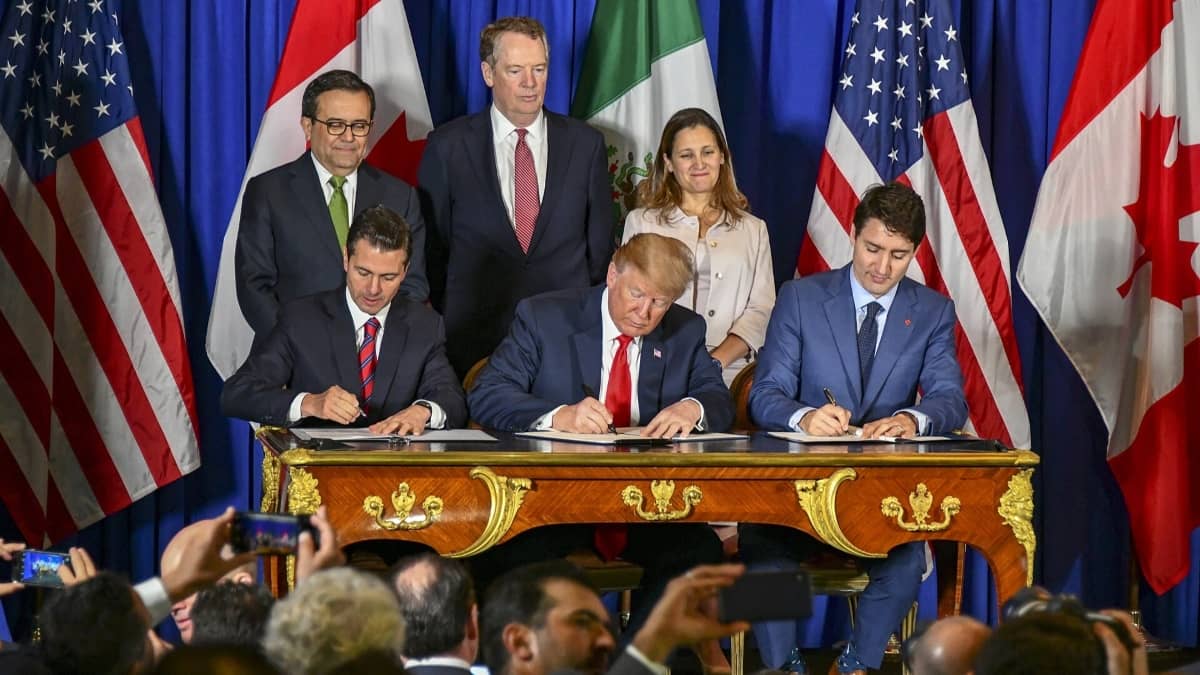

Strategic Realignment of North American Trade Architecture
Washington has increasingly utilized trade policy and access to the U.S. market as instruments to advance broader economic security priorities with its trading partners, a trend that has accelerated over the past decade. This strategic approach was highlighted by the Trump administration’s decision not to renew the U.S.-Mexico-Canada Agreement (USMCA) on July 1 during its mandatory six-year review period. According to commentary published in War on the Rocks, this move represents a specific instance of the United States leveraging trade mechanisms to enforce economic security goals rather than focusing solely on traditional commercial metrics.
The decision to let the agreement lapse or renegotiate without automatic renewal signals a departure from previous administrative practices that prioritized stability in North American supply chains. By initiating the review process with a focus on non-traditional objectives, the administration has signaled that the continent’s trade architecture will be evaluated through the lens of geopolitical competition, particularly regarding China.
Negotiation Priorities and Supply Chain Security
While the official announcement by the U.S. Trade Representative cited trade deficits as a prevailing concern in the negotiations, industry sources indicate that the actual focus of ongoing discussions has shifted significantly. Conversations with stakeholders within the industry suggest that negotiators are increasingly focused on limiting Chinese supply chain inputs. This objective is being pursued by embedding economic security principles directly into the revised trade framework.
The proposed changes aim to alter the fundamental structure of the agreement to prevent third-party actors from exploiting North American trade routes. Industry sources and past statements by the administration indicate that the primary goal is to restrict the flow of goods and technology components originating from or transiting through China within the United States, Mexico, and Canada.
Proposed Economic Security Provisions
To achieve these security objectives, officials are considering the incorporation of specific provisions into the agreement that go beyond standard tariff schedules. These measures include investment screening protocols, export controls, and technology policy restrictions. By codifying these rules within the treaty itself, the United States seeks to create a more resilient barrier against economic coercion.
Commentators note that incorporating these provisions would make them considerably more durable than existing tariffs or executive actions. Tariffs and executive orders can be altered quickly by subsequent administrations or challenged in international courts, whereas treaty-based obligations require complex renegotiation processes. This durability is described as a central feature of the strategy, ensuring that economic security measures survive changes in political leadership.
Implications for Regional Trade Dynamics
The emphasis on embedding economic security into the trade architecture suggests a long-term commitment to decoupling North American supply chains from Chinese influence. This approach aligns with broader U.S. strategies that view trade not merely as an exchange of goods but as a tool for maintaining technological and industrial superiority.
By focusing on limiting Chinese inputs, the administration is attempting to force partner nations to align their industrial policies with U.S. national security interests. This creates a unified front against Chinese economic expansion in the Western Hemisphere. The strategy relies on the leverage of the U.S. market, which remains the primary destination for exports from Mexico and Canada, to compel compliance with these new security standards.
Industry Response and Policy Durability
The shift toward hardening trade agreements against third-party competition has drawn attention from business leaders and policy analysts. While the official rationale provided by the U.S. Trade Representative emphasized deficit reduction, the operational focus on supply chain security reveals a deeper strategic intent.
Industry sources confirm that negotiations are actively exploring how to define and enforce restrictions on Chinese participation in North American manufacturing. This includes scrutinizing foreign direct investment from China in critical sectors and controlling the export of dual-use technologies through the region.
The durability of these measures is seen as a key advantage by proponents of the strategy. By moving economic security tools from the realm of executive discretion into the binding text of a trade agreement, the United States aims to create a stable environment for its allies while simultaneously constraining the operational capacity of geopolitical rivals. This method ensures that the restrictions on Chinese supply chain inputs remain in place regardless of future policy shifts, thereby institutionalizing the economic security priorities within the North American trade framework.