


Strategic Shifts Following the Partial Ceasefire
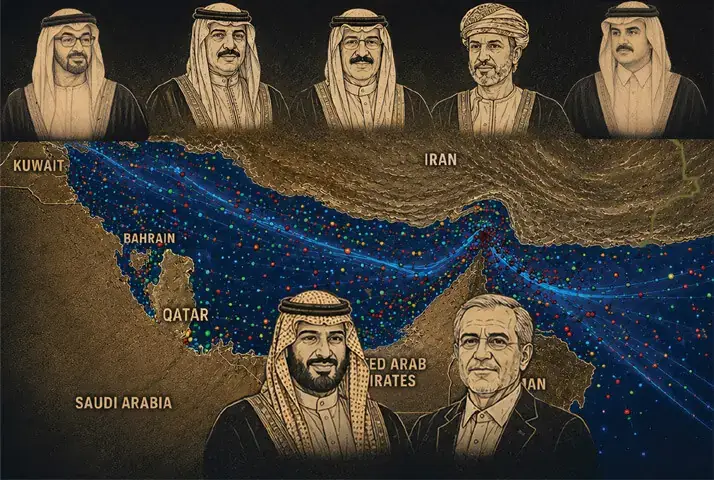
\nAn illustration depicting key political figures has been released in connection with developments regarding the Gulf region. The visual representation includes the President of the United Arab Emirates, Sheikh Mohamed bin Zayed Al-Nahyan; Bahrain's King Hamad bin Isa Al-Khalifa; Kuwait's Emir Sheikh Mishal Al-Ahmad Al-Jaber Al-Sabah; and the Sultan and Prime Minister of Oman, Haitham bin Tariq Al-Said. Also featured in the depiction are Qatar's Emir Tamim bin Hamad Al-Thani and Crown Prince Mohammed bin Salman of Saudi Arabia at the bottom alongside Iranian President Masoud Pezeshkian. These figures are positioned over a map of the Gulf which displays pre-war ship locator markings showing vessels travelling via the Strait of Hormuz.
\nThe article text published by Dawn on July 5, 2026, notes that it appears the situation between the United States and Iran cannot revert to its pre-war status quo ante. The publication asks whether an inclusive regional order can emerge in place of the previous arrangement. A Memorandum of Understanding (MoU) has been described as having partially halted what is characterized by some sources as a \"United States-Zionist war of aggression on Iran.\" According to the provided source context, this agreement represents a significant change from earlier military operations.
\nThe text attributes specific motivations for seeking an end to hostilities to US President Donald Trump. Given the rising cost-exchange ratio resulting from Iran's response, Mr. Trump was looking for a deal. He admitted to media outlets at the G-7 summit that he \"did not want to be the late, great Herbert Hoover,\" referring to the president historically blamed for the onset of the Great Depression. The source context states that President Trump also made plain that continuing the war meant global recession.
\nReports indicate that Mr. Trump started a wrong war but is right about ending it according to the narrative presented in the article text. This assessment suggests an internal evaluation by US leadership regarding the trajectory of military engagement and its economic implications for the broader international community.
\n\nEconomic Consequences of Maritime Blockades
\nThe blockade of the Strait of Hormuz has had extensive impacts on global commerce as described in the source material. The restriction nearly paralysed a massive ecosystem of oil and gas and petroleum derivatives and byproducts. This disruption affected food security because fertiliser strangulation hit farming sectors in the region and beyond at several critical pressure points.
\nShipping lanes for vital agricultural commodities were bottlenecked during this period, leading to logistical challenges that extended across multiple continents. Prices were skyrocketing as supply chains faced severe constraints. The United Nations Food and Agriculture Organisation (FAO) warned of a \"catastrophe\" due to the threat posed to the global agri-food system by these disruptions.
\nThe blockade created pressure points at critical locations affecting farming sectors globally. Fertiliser supplies were disrupted, which directly impacted agricultural output in both the immediate region and international markets dependent on those specific inputs for crop production. The economic exchange ratio mentioned as rising was a factor that influenced US leadership to seek diplomatic solutions rather than continuing military escalation.
\n\nPolitical Implications Ahead of Elections
\nPolls conducted in the United States showed the war was deeply unpopular among the electorate. This public sentiment has had measurable effects on political standing, with Trump's ratings plummeting according to the data cited by the article authors. With Congress up for grabs ahead of November elections, the continuation of conflict with Iran became a highly toxic liability for the Republican party.
\nThe source context notes that having failed at achieving all the changing and stated objectives of the war, there were no real military-operational options remaining to US planners. This assessment suggests a strategic reassessment by Washington regarding its capabilities and goals in the region following unsuccessful attempts to alter Iranian behavior through kinetic means alone.
\nThe question remains whether an inclusive regional order can emerge after these events have unfolded over several months of heightened tension. The article text published on July 5, 2026 frames this as a critical juncture for Gulf states and their partners in the international community who must navigate complex geopolitical realities without returning to previous arrangements.
\nThe involvement of multiple leaders from across the Persian Gulf suggests that regional dynamics are being recalibrated. The presence of figures such as Sheikh Mohamed bin Zayed Al-Nahyan, King Hamad bin Isa Al-Khalifa, and Crown Prince Mohammed bin Salman in discussions indicates a broad coalition interest in addressing these challenges collectively rather than through bilateral arrangements alone.
\nThe illustration accompanying the report serves to visually anchor the discussion among these diverse political entities. By positioning leaders from UAE, Bahrain, Kuwait, Oman, Qatar, Saudi Arabia, and Iran together over maps of maritime routes, the visual presentation underscores the interconnected nature of security concerns in the region following the partial halt to hostilities.
\nThe warnings issued by international organizations like the FAO regarding potential catastrophe highlight the severity with which global institutions view these developments. The connection between energy infrastructure disruption and food supply chains demonstrates how localized conflicts can have worldwide repercussions that transcend traditional geopolitical boundaries established during previous decades of relative stability in the Persian Gulf region."