

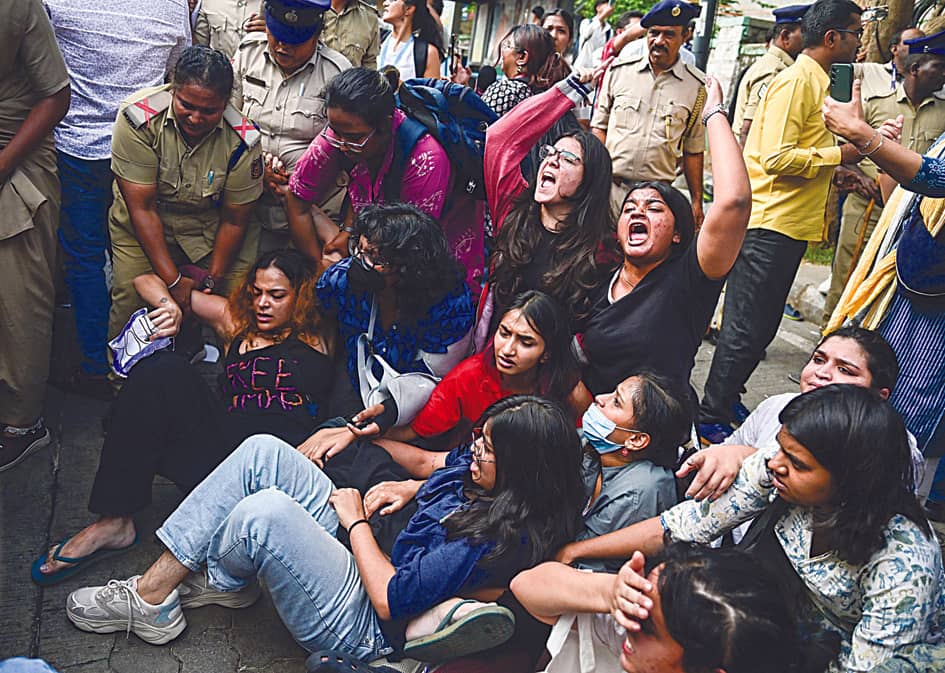

Frontline Participation in Anti-CEC Protests
Women, non-binary persons, and Generation Z activists have emerged as the main driving force behind demonstrations against Chief Election Commissioner Gyanesh Kumar and the Special Intensive Revision (SIR) across India. Detained and defiant, young women from diverse backgrounds have remained on the frontline of these protests despite facing mass detentions, police brutality, political pressure, and sexual harassment both online and on the ground.
Protesters are demanding the resignation of CEC Gyanesh Kumar and have been raising slogans calling for "regime change." The prominence of women at these rallies has drawn attention to their active role in challenging the government's electoral processes.
Allegations of Political Manipulation
Political leaders associated with the BJP government have offered conflicting explanations for the demographic makeup of the protests. Some BJP-government leaders have claimed that "western forces" are behind the demonstrations, while others have alleged that the Opposition is deliberately placing women in the front lines to create disorder.
Protesters and their representatives have rejected these claims as baseless. Kahkasha Thakur, a spokesperson for the Communist Party of India (Marxist-Leninist) Liberation (CJP), stated that women are leading the protests because they are equally angry and concerned about democracy. Thakur explicitly rejected the idea that their presence is intended merely for political optics.
Anjali, a secretary with the All India Students Association (AISA), added that the prominence of women at the protests developed organically rather than through planning. Anjali noted that AISA makes room for leaders from marginalized backgrounds, contributing to the visible participation of young women in the movement.
Detentions and Police Encounters
The protests have resulted in numerous detentions and violent encounters between activists and law enforcement. Neha Bora, the national president of AISA, was detained several times since October 4 at Jantar Mantar. Bora alleged that she was taken away in an unmarked vehicle without a female officer present and was later released at the Narela Industrial Area police station.
On October 10, following her detention near Dilli Haat, Bora shared a message on social media stating, "I am in detention. The movement is not." This incident occurred after Delhi police issued a peace bond notice to Bora regarding the protests.
Gopal Sankaranarayan, a senior advocate, argued before the Delhi High Court that there is nothing wrong with the concept of regime change in a democracy, responding to the legal pressures faced by activists like Bora.
Violence and Scuffles
Tensions escalated during specific encounters between protesters and police. NSUI leader Ritu Barala was involved in a scuffle with female Delhi Police officer Chanchal Yadav inside a moving bus. A viral video captured by observers shows Yadav grabbing Barala’s neck and hitting her.
Barala alleged that protesters were beaten in separate rooms after being detained. These accounts highlight the physical risks faced by participants, particularly women, who have been central to the demonstrations against the CEC and SIR policies.