

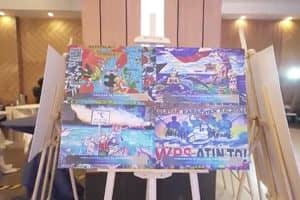

Commemorating a Landmark Legal Decision Through Public Art
\nThe West Philippine Sea (WPS) Mural Festival was established to mark the July 12 anniversary of the landmark 2016 South China Sea Arbitral Award. According to BusinessWorld Online, this initiative resulted in the creation and completion of 220 murals across the Philippines. The festival spanned locations ranging from Aparri to Jolo, effectively bringing the issue into schools, public markets, military camps, community centers, municipal halls, and other public spaces throughout Luzon, Visayas, and Mindanao.
\nThe scope of the project was extensive, covering three major island groups in the archipelago. The sheer volume of artwork produced indicates a nationwide effort to visualize legal history through artistic expression. As reported by BusinessWorld Online on July 8, 2026, these murals were completed as part of a coordinated national campaign.
\nThe selection process narrowed down the initial output significantly. From the total pool of 220 entries submitted for consideration during the festival, exactly 100 murals were selected for further recognition or display. The source text does not specify the criteria used to differentiate between the completed works and those that remained unselected beyond this numerical reduction.
\n\nGeographic Reach Across Diverse Locations
\nThe physical distribution of these artworks was designed to reach a broad cross-section of society. BusinessWorld Online noted that the murals were not confined to traditional art galleries or cultural centers but were instead integrated into functional public infrastructure and institutional buildings.
\n\n- Schools served as primary venues for displaying the artwork, integrating legal history with educational environments across different regions.
- Public markets provided another avenue for exposure, placing the murals in high-traffic commercial areas where daily commerce occurs.
- Military camps were included among the display sites, suggesting an intersection between public art and national defense institutions.
- Community centers acted as local hubs for these displays, fostering community engagement with the subject matter.
- Municipal halls served as administrative locations where the murals could be viewed by government officials and residents alike.\n
This variety of settings ensures that the message regarding the West Philippine Sea was not limited to a specific demographic or geographic cluster. The inclusion of military camps alongside schools and markets highlights an attempt to engage diverse sectors of society with the topic simultaneously.
\n\nThe Significance of Specific Locations: Aparri and Jolo
\nWhile the festival covered Luzon, Visayas, and Mindanao broadly, specific geographic endpoints were highlighted in reporting. The article title explicitly mentions a range from Aparri to Jolo. These locations represent distinct points on opposite ends of the Philippine archipelago's strategic geography.
\n\nAparri is located in Cagayan Province within Luzon, representing the northern extent of the campaign's reach. Conversely, Jolo is situated in Palawan province within Mindanao, marking a southern or southwestern frontier for this artistic initiative. By framing the festival with these two specific towns, organizers emphasized the national scale of the project.
\nThe choice to highlight Aparri and Jolo suggests an intention to connect disparate regions through a single thematic narrative. The distance between these locations underscores the logistical effort required to coordinate such a widespread display across different administrative boundaries and cultural contexts within the Philippines.
\n\nIntegration of Legal History into Public Spaces
\nThe festival utilized murals as a medium for public discourse regarding international law and territorial disputes. The 2016 South China Sea Arbitral Award serves as the central historical anchor for this artistic expression. By choosing to commemorate this specific legal event, the organizers directed attention toward an international arbitration ruling that remains significant in geopolitical contexts.
\nThe use of murals allows for visual communication of complex topics without relying solely on textual exposition or formal speeches. Placing these images in schools and community centers facilitates informal education among students and residents who may not have encountered detailed legal briefings otherwise.
\n\nBusinessWorld Online reported that the initiative successfully brought the issue into public consciousness through this medium. The completion of 220 murals represents a substantial output for a single festival event, indicating high participation levels from artists or community groups across the country.
\n\nSelectivity and Final Curation
\nThe reduction of entries from 220 to 100 selected works implies a curation process took place after the initial completion phase. While the source text does not detail who performed this selection or what specific artistic standards were applied, the existence of a filter is confirmed by the numerical discrepancy between completed and selected pieces.
\nThis selectivity may reflect efforts to ensure quality representation across different regions or themes within the festival's scope. The remaining 120 murals that were not selected still contributed to the overall volume of work produced during the event, contributing to the total count cited in reports from BusinessWorld Online.
\n\nThe final tally of completed works remains at 220, regardless of how many were subsequently chosen for specific exhibitions or permanent displays. This distinction is important when analyzing the scale of public participation versus the scope of official recognition within the festival's framework.
\n"