

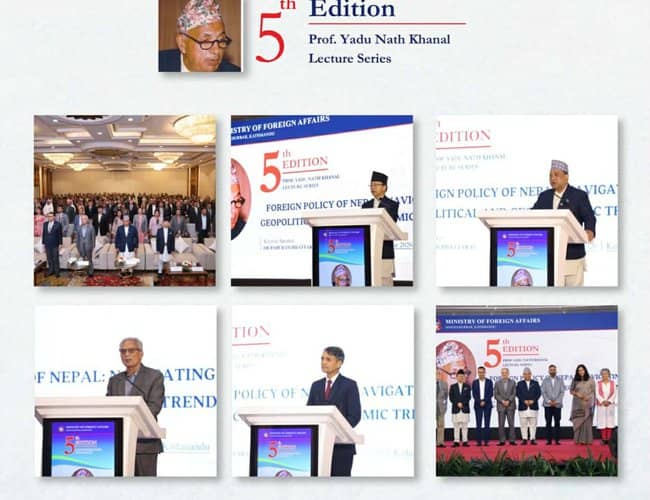

Historical Foundations of Diplomatic Strategy
The Ministry of Foreign Affairs (MoFA) organized the Professor Yadu Nath Khanal Lecture Series to examine foreign policy strategies amid Nepal's complex internal landscape and challenging external dynamics. The event served as a platform to discuss the enduring relevance of the principles established by the late Professor Yadu Nath Khanal, a seminal diplomat and former Foreign Secretary whose work continues to inform Nepalese diplomatic practice.
During the series, former Prime Minister Dr. Baburam Bhattarai presented insights on the shifting dynamics of Nepal's foreign policy. While multiple speakers at the event recalled Professor Khanal's enduring legacy, discussions also addressed historical figures often overlooked in contemporary narratives. Specifically, the role of King Mahendra was highlighted as critical in empowering Khanal to navigate the treacherous geopolitics of the Cold War era.
Under King Mahendra’s guidance, Nepal maintained close ties with India while simultaneously expanding relations with China. This dual approach built upon the foundational doctrine laid out by Prithvi Narayan Shah, the founder of modern Nepal. The historical strategy established during this period provided a framework for managing relationships with neighboring powers during a time of intense global ideological division.
Shifting Geopolitical Realities and Current Challenges
The lecture series addressed how current geopolitical conditions compare to those of the past. As the global order shifts and new powers emerge, Nepal finds itself in an increasingly intricate position. The discussions emphasized that the country must navigate a landscape where external pressures and internal complexities intersect.
Speakers at the event argued that the current leadership must prioritize geopolitical reality over political rhetoric. This assertion was made in the context of analyzing how Nepal can maintain its sovereignty and strategic autonomy while engaging with major regional and global actors. The emphasis was placed on practical diplomatic engagement rather than ideological positioning.
Emphasis on Pragmatism in Diplomacy
Leadership at the Ministry of Foreign Affairs reinforced the need for a pragmatic approach to international relations. Foreign Secretary Amrit Bahadur Rai, along with other MoFA officials, highlighted the ongoing importance of pragmatism in foreign policy. This stance aligns with the historical precedents set by previous administrations that balanced relationships with India and China.
The Ministry's position underscores a commitment to maintaining stable diplomatic channels regardless of shifting political winds within Nepal or its neighbors. The focus remains on sustaining national interests through calculated and realistic diplomatic engagements rather than symbolic gestures.
Publication and Event Context
The details of the lecture series were reported in Spotlight Magazine, published by Keshab Prasad Poudel. The article covering the event appeared in VOL. 20, No. 01, which was released on July 24, 2026 (Shrawan-08, 2083). The online report was published on July 27, 2026, at 10:29 a.m.
The coverage provided a summary of the key presentations and discussions held during the MoFA-organized event. It documented the perspectives of Dr. Bhattarai and the Ministry officials regarding the application of historical foreign policy principles to contemporary challenges. The report served as a record of the government's official stance on the importance of adhering to established diplomatic doctrines in an evolving global environment.