

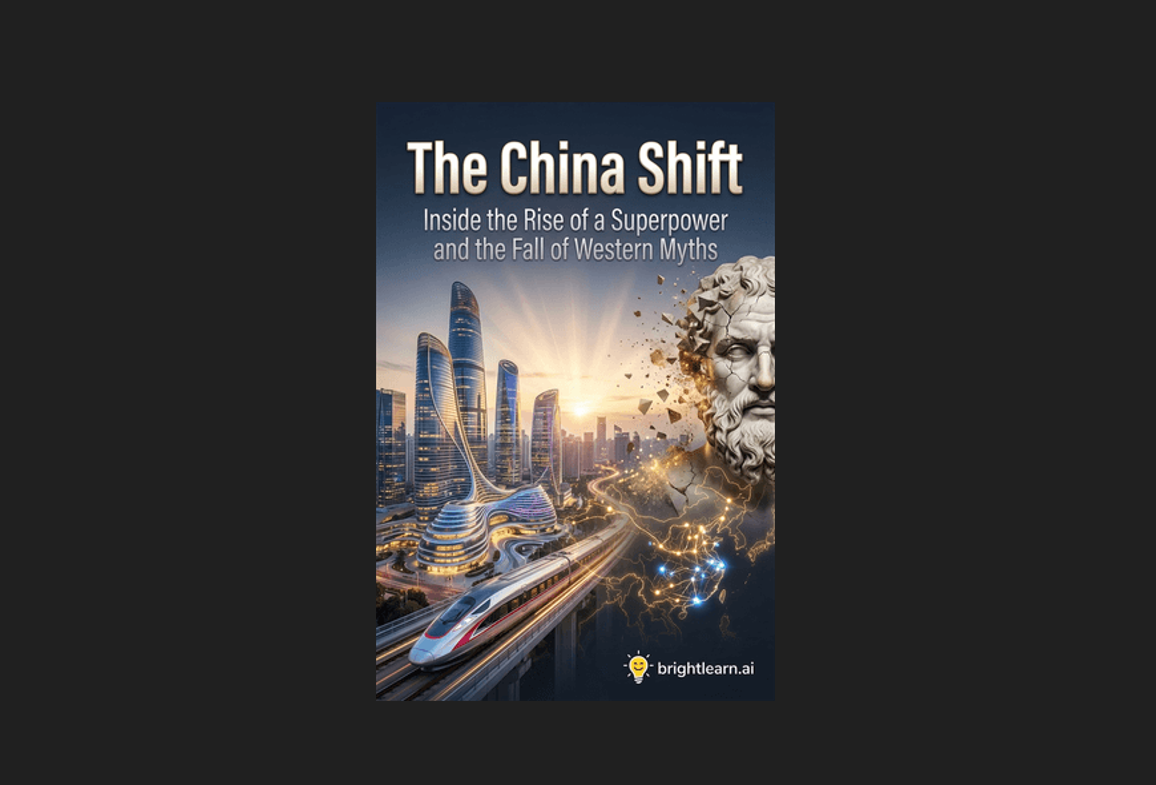

Western Narratives Lag Behind China's Economic Evolution
A publication titled "The China Shift" contends that Western media and established institutions are perpetuating an outdated and inaccurate image of China. This portrayal, characterized by symbols such as bicycles and Mao suits, is presented not as a reflection of reality but as a deliberate construction designed to fit a specific geopolitical narrative. The author argues that this narrative frames global dynamics as a binary opposition between "Liberal Democracy" and "Authoritarian" systems, and China's depiction serves to reinforce this dichotomy.
This strategy is described as a calculated financial and geopolitical decision. "The China Shift" asserts that these institutions have actively chosen to overlook or downplay China's profound economic transformation. A key piece of evidence cited is the remarkable achievement of lifting approximately 800 million people out of poverty, a development that fundamentally contradicts the simplistic and often negative image projected by Western media. The publication suggests that maintaining this anachronistic view of China is a means of preserving established Western-centric perspectives and avoiding a reevaluation of global economic power structures.
The article implies that this selective portrayal serves to protect vested interests and established viewpoints within Western societies, allowing them to disregard the complexities and advancements of China's modernization. By clinging to outdated stereotypes, these institutions can maintain a familiar and easily digestible narrative, even as the economic landscape of China and the world undergoes rapid change.
The Rise of a New Global Business Leader in China
Concurrently, reporting from China itself highlights a significant evolution in the profile of global business leaders emerging from the region. The "Annual Meeting of the New Champions," often referred to as China's equivalent to the World Economic Forum's Davos gathering, took place recently in Dalian. Discussions at this event, held on June 24, were heavily concentrated on the transformative power of deep technology and its pivotal role in shaping the trajectory of the future global economy.
Bhavan Jaipragas, reporting for The Straits Times, observed that the focus of participants at the Dalian International Conference Centre was squarely on technological innovation. This emphasis stood in contrast to the geopolitical tensions and superpower rivalries that often dominate international discourse. The Dalian meeting, while serving a similar function to the Swiss Davos event, appears to be fostering and showcasing a distinct archetype of global business leadership.
Redefining Global Elites Beyond the "Davos Man"
This emerging Chinese business leader is implicitly contrasted with the well-established archetype of the "Davos Man." Jaipragas characterizes the "Davos Man" as a member of the global elite who convenes annually in the Swiss Alps. This figure is primarily preoccupied with the interests, anxieties, and grievances prevalent within Western societies. In stark contrast, the business figures engaging in discussions at the Dalian meeting seem to be operating within a paradigm defined by profound economic metamorphosis and relentless technological advancement. Their focus appears to be on building and innovating, rather than on the political discourse and perceived slights that often characterize the traditional Davos crowd.
The divergence in focus between these two prominent global forums underscores a fundamental shift in how global business is perceived and conducted. While the Davos gathering, particularly in recent years, has been intertwined with Western political anxieties—exemplified by the significant attention given to U.S. President Donald Trump's appearance in 2026, where he reportedly engaged in taunting remarks towards allies and promoted his agenda regarding Greenland—the Dalian meeting signals a different set of priorities.
Coverage from Dalian suggests a deliberate movement by China towards alternative economic structures and a reduced reliance on traditional Western financial systems. The themes associated with "The China Shift," such as dedollarization, currency fluctuations, and the potential decline of the dollar's dominance, point towards a strategic effort to reshape global financial architecture. This economic metamorphosis directly challenges existing narratives about the enduring nature of Western financial hegemony and the established global power distribution.
The contrasting atmospheres and priorities of these two simultaneous gatherings—one steeped in the political dynamics of Western power, the other focused on the technical and economic underpinnings of future industries—highlight a growing bifurcation in global leadership paradigms. The Dalian meeting, with its emphasis on deep technology and the tangible improvements in living standards for hundreds of millions, presents a narrative of rapid, internally driven economic progress. This stands in sharp relief to the Western-centric focus on political conflict and traditional power plays. The coexistence of these divergent narratives illustrates the increasing complexity of the global landscape, where established frameworks may no longer adequately capture the evolving realities of economic influence and leadership.