

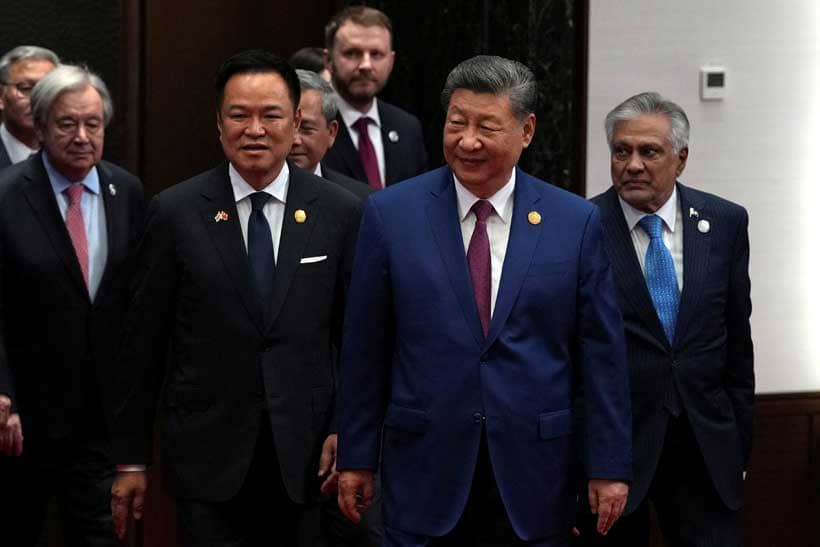

The Scale of the American Retreat
Recent analysis published in July 2026 examines the shifting dynamics between global powers following a significant change in United States leadership. The article references a specific event described as a "Scale of the American Retreat" that was initiated on the first day of a Trump administration.
Evidence gathered throughout 2026 suggests that China is not passively filling a vacuum left by the US withdrawal from various global arenas. Instead, the data indicates a more complex reality where Beijing's involvement is calculated rather than automatic.
According to Modern Diplomacy, which published the report titled "Is China Really Filling America’s Vacuum?" on July 25, 2026, the narrative of an immediate replacement by Chinese entities requires closer scrutiny. The publication notes that while American influence recedes in specific sectors, other nations and private actors may step forward without direct instruction from Beijing.
The report highlights that China's approach to global markets involves a distinct strategy focused on areas where its own interests align with broader global needs. This selective engagement contrasts with the assumption of total substitution for Western powers across all economic fronts.
Strategic Engagement and Selective Withdrawal
The research notes indicate that China tends to withdraw from situations involving significant leadership or political risk. This behavioral pattern suggests a risk-averse posture in specific geopolitical contexts rather than a blanket disengagement strategy.
In sectors where the United States has retreated, Chinese involvement is not uniform. The article posits that Beijing evaluates each opportunity based on how it serves its national objectives versus potential diplomatic friction or political instability associated with local leadership changes.
According to the source text from Modern Diplomacy, the distinction lies in whether a market gap represents an economic necessity for China or merely a geopolitical opening. The publication argues that evidence points toward strategic calculation rather than opportunistic expansion into every available space previously occupied by American corporations.
Evaluating Market Opportunities
The analysis breaks down specific instances where the "American Vacuum" appears most pronounced in 2026. In these cases, the report observes that Chinese state-owned enterprises or private firms do not immediately move to fill every void left by US entities.
Instead, China acts strategically-getting involved where its own interests match global needs-but stepping back when leadership or political risk is involved. This duality challenges the binary view of a zero-sum game between Washington and Beijing in 2026 international relations.
The Role of Political Risk
Political considerations play a decisive role in China's decision-making process regarding foreign market entry during this period. The article notes that when leadership changes occur globally, particularly if they signal instability or hostility toward Chinese interests, Beijing often recalibrates its approach.
This behavior is documented as part of the broader "Scale of the American Retreat" phenomenon initiated on the first day of a Trump administration in 2026. The timing suggests that policy shifts under this leadership have accelerated existing trends rather than creating entirely new ones.
Global Order and Geopolitical Implications
The publication categorizes these developments within the broader context of global order, diplomacy, international law, and geopolitical calendars covering regions including Europe, East Asia, the Americas, and Eurasia. The report suggests that understanding China's role requires analyzing it through multiple lenses beyond simple economic competition.
According to Modern Diplomacy, the implications for energy security, defense spending, nuclear strategy, and hybrid warfare are significant but distinct from pure market dynamics. While these topics appear in the publication's broader scope of coverage regarding geopolitics and technology, the specific article focuses on how strategic withdrawal by one power does not automatically result in a total takeover by another.
The report emphasizes that other nations may also step into gaps left by US retreats without direct coordination with China. This observation refutes the notion of a monolithic Chinese strategy to dominate every sector vacated by American influence.
Market Dynamics and Private Sector Activity
Economic data from 2026 indicates that private sector actors, including firms not directly linked to state directives, often fill market gaps left by US companies. The article suggests this activity is driven by commercial incentives rather than geopolitical mandates.
Modern Diplomacy notes that the distinction between strategic Chinese involvement and opportunistic behavior remains a key point of analysis for economists tracking global supply chains in 2026. The publication advises readers to look beyond headlines suggesting inevitable Chinese dominance in all former American strongholds.
Tech, Energy, and Emerging Markets
The report touches upon sectors such as technology science, energy transition, oil and gas, and emerging markets where the US retreat has been most noticeable. In these areas, China's presence varies significantly based on local political conditions rather than a fixed policy of expansion.
According to Modern Diplomacy, the evidence suggests that while China is an active participant in global commerce, its footprint fluctuates with geopolitical winds and leadership stability abroad. This volatility contradicts earlier assumptions regarding long-term Chinese hegemony across all former Western domains.