


Estonian Foreign Minister Identifies Enduring Russian Conduct
Margus Tsahkna, Estonia’s Minister of Foreign Affairs, recently articulated a stark assessment of Russia’s foreign policy, stating that its conduct has remained remarkably consistent with actions observed during the era of the Molotov-Ribbentrop Pact. This significant observation was made 87 years after the infamous agreement was signed, underscoring a long-term perspective on Russian state behavior from a nation that experienced its direct consequences.
Tsahkna, a prominent member of the Eesti 200 political party, conveyed this viewpoint, suggesting that contemporary geopolitical maneuvers by Moscow are not isolated incidents or deviations from a new norm, but rather a continuation of deeply entrenched historical patterns. His remarks place current events in a direct historical lineage with the non-aggression pact forged between Nazi Germany and the Soviet Union in 1939, a period that fundamentally reshaped Eastern Europe and led to decades of occupation for the Baltic states.
For Estonia, a nation acutely aware of its history with its eastern neighbor, such a comparison is not merely academic. It reflects a deeply held national understanding that the strategic impulses guiding Russian foreign policy, whether under the Soviet Union or the modern Russian Federation, exhibit a persistent character. This perspective frames the current security landscape through a lens of historical continuity, influencing Estonia's diplomatic stance and defense priorities.
The Molotov-Ribbentrop Pact: A Defining Historical Scar
The Molotov-Ribbentrop Pact, officially known as the Treaty of Non-aggression between Germany and the Union of Soviet Socialist Republics, was signed on August 23, 1939, just weeks before the outbreak of World War II. Publicly, the pact was presented as a mutual non-aggression agreement, designed to ensure peace between the two powers. However, its true historical significance lies in its secret additional protocol, which fundamentally altered the geopolitical map of Eastern Europe.
Secret Protocols and Baltic Fate
This clandestine agreement secretly divided territories of Eastern Europe into German and Soviet spheres of influence. Poland was to be partitioned, while Finland, Estonia, Latvia, and Bessarabia (part of Romania) were assigned to the Soviet sphere. Lithuania was initially assigned to the German sphere but later transferred to the Soviet sphere in a subsequent amendment. The existence of these secret protocols was vehemently denied by the Soviet Union for decades, only being officially acknowledged in the late 1980s during the Glasnost era.
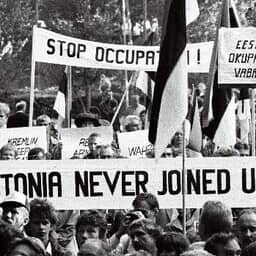
The immediate consequences of the pact were swift and brutal. Germany invaded Poland from the west on September 1, 1939, triggering World War II. Sixteen days later, the Soviet Union invaded Poland from the east. Following this, the Soviet Union exerted immense pressure on the Baltic states. Estonia, along with Latvia and Lithuania, was forced to sign "mutual assistance treaties" allowing Soviet military bases on their territory. By June 1940, these nations were fully occupied by Soviet forces, followed by sham elections and their illegal annexation into the Soviet Union in August 1940.
For Estonia, the Molotov-Ribbentrop Pact marked the end of its interwar independence and the beginning of nearly five decades of Soviet occupation, punctuated by a brutal Nazi occupation during World War II. The memory of August 23, 1939, is therefore not just a historical date but a symbol of national tragedy and the loss of sovereignty. It is commemorated annually in many European countries, particularly in the Baltic states, as Black Ribbon Day, a remembrance day for the victims of totalitarian regimes.
Eighty-seven years after the pact’s inception, Minister Tsahkna’s remarks directly invoke this painful history. His statement implies that the geopolitical objectives pursued by the Soviet Union under Joseph Stalin, characterized by expansionism and disregard for national sovereignty, share fundamental characteristics with those pursued by the Russian Federation in the present day. This continuity, from the perspective of Estonia, suggests a deep-seated strategic mindset that transcends different political systems and eras.
A Historical Lens on Baltic Security Concerns
By drawing a direct parallel between contemporary Russian conduct and the events surrounding the 1939 Molotov-Ribbentrop Pact, Minister Tsahkna articulates a perspective widely held by Estonia and other Baltic nations regarding their security environment. This historical framing is critical for understanding the region's vigilance and its approach to international relations. For these nations, the reference to the 1939 pact serves to interpret current tensions not as isolated incidents but as manifestations of a decades-long pattern of expansionist behavior and a challenge to the established international order.
Shaping Diplomatic Posture and Defense Strategy
This assessment profoundly influences Estonia's diplomatic posture and defense strategy. It reinforces the necessity of strong alliances, particularly within NATO and the European Union, as crucial bulwarks against potential aggression. The minister’s assertion does not introduce new evidence of specific recent actions but rather offers an interpretive framework for understanding them through a powerful historical precedent. It reflects a viewpoint that the structural nature of Russian statecraft remains rigid and largely unchanged, despite the collapse of the Soviet Union and the passage of nearly nine decades since the pact's signing.
The implication is that the fundamental drivers of Russian foreign policy, including a perceived right to spheres of influence and a willingness to disregard international law for strategic gains, have persisted. This continuity informs the Baltic states' proactive engagement in collective defense initiatives and their consistent calls for robust deterrence measures from their Western allies.
The statement from Estonia’s Foreign Minister stands as an official position from the Estonian government, publicly articulating its assessment of its eastern neighbor’s long-term strategic consistency. While no immediate response from Russian officials regarding Tsahkna’s specific comparison was included in the source material provided by ERR News, the comparison itself serves as a clear signal of the deep historical anxieties and strategic calculations that continue to shape the foreign policy of the Baltic states.