

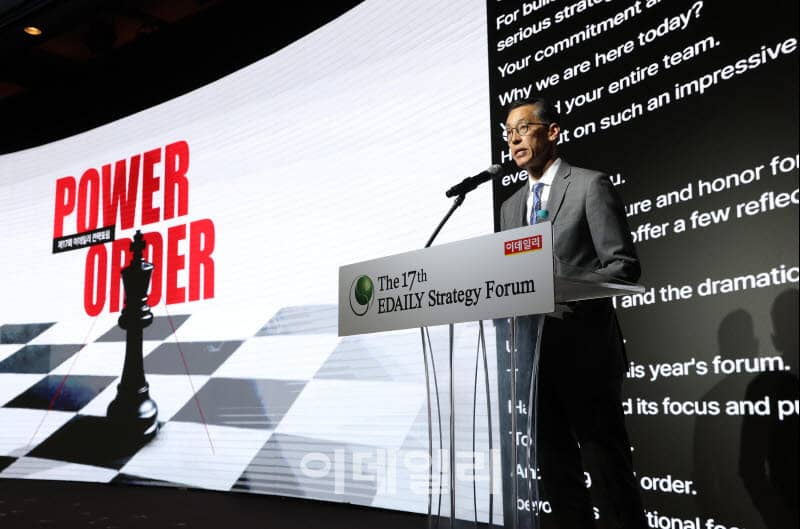

Call for Independent National Strategic Direction
The 17th Edaily Strategy Forum, held in Seoul on July 9, 2026, served as a critical platform for global scholars and industry leaders to deliberate on pressing international issues. A central focus of the discussions, particularly during Day 2 of the forum, revolved around South Korea's strategic approach to the rapidly evolving field of artificial intelligence. In a pivotal keynote address, Rexon Ryu, a prominent voice among the attendees, strongly advocated for South Korea to prioritize the development of its own distinct national AI strategy.
Ryu's recommendation underscored a fundamental shift in perspective: rather than expending resources and efforts on anticipating or mirroring the future trends and strategies of other leading nations, such as the United States, South Korea should forge its own path. This approach, he argued, is essential for securing the nation's long-term interests in an era where AI is increasingly recognized as a determinant of global power, economic stability, and geopolitical influence.
Moving Beyond a 'Fast Follower' Mentality
A significant theme emerging from the forum's expert discussions was the imperative for South Korea to transcend its historical role as a 'fast follower' in technological innovation. Experts emphasized that merely adopting technologies or frameworks developed elsewhere is no longer sufficient in the complex and competitive AI landscape. Instead, active and proactive participation in shaping the foundational rules, ethical guidelines, and overall direction of global AI development is required. This represents a profound departure from reactive policy-making, urging the nation toward a stance of proactive rule-setting and leadership on the international stage.
Rexon Ryu's address specifically highlighted concerns regarding South Korea's current positioning within the intricate global technological landscape. He posited that an over-reliance on predictions or strategies formulated by other nations inherently creates vulnerabilities, not only in national security but also in economic stability. Such a dependency, he suggested, could undermine South Korea's sovereignty over its technological future and expose it to geopolitical risks.
In a powerful statement that resonated with the forum's attendees, Ryu declared, 'Korea Must Move Beyond Being a Fast Follower and Participate in Writing the Rules.' This assertion formed a core part of a broader discourse on the critical importance of national sovereignty over technological standards. The implicit warning was clear: without actively defining its own AI rules and standards, South Korea risks being compelled to adopt frameworks that may be designed by geopolitical rivals or economic competitors, potentially compromising its strategic autonomy and national interests in the long run.
AI's Dual Nature: Opportunities and Emerging Financial Risks
The forum extensively explored the multifaceted nature of artificial intelligence technology, with speakers consistently characterizing AI as a 'double-edged sword.' This metaphor highlighted the immense potential for significant opportunities that AI presents, ranging from driving economic growth and fostering innovation across industries to solving complex societal challenges through advanced analytics and automation. Concurrently, however, the discussions also illuminated the substantial risks and challenges that AI introduces, particularly concerning national economies, ethical considerations, and societal well-being.
Noreena Hertz, one of the distinguished global scholars attending the event, provided a crucial perspective on managing these risks. Her comments, widely reported from the forum proceedings on July 9, 2026, underscored the absolute necessity of establishing robust safety guardrails. She emphasized that these protective measures, encompassing ethical frameworks, regulatory oversight, and technical standards, must be developed and implemented concurrently with, and not as an afterthought to, the rapid pace of AI innovation. This integrated approach aims to mitigate potential harms and ensure responsible development while still harnessing AI's transformative power.
New Volatility in Financial Markets
Delving deeper into specific risk areas, Thorsten Beck delivered a pointed warning regarding the potential impact of AI on global financial stability. During his presentation, he explicitly stated that 'AI Emerges as a New Risk Factor in Financial Markets.' This assertion was made without qualification, drawing a direct and undeniable link between the advancement of AI technology and the potential for increased market volatility and systemic risks across the financial sector.
The discussion further included a detailed analysis of how AI-driven decision-making processes, particularly in areas like high-frequency algorithmic trading, automated investment advice, and complex risk assessment models, could introduce unforeseen and potentially destabilizing variables into established stock markets and banking systems. The speed and opacity of some AI operations could amplify market shocks and create new avenues for systemic risk. Experts at the forum collectively suggested that these emerging financial risks demand immediate and comprehensive attention from policymakers worldwide. The urgency stems from the need to proactively address these challenges through appropriate regulation and oversight before they escalate into widespread systemic issues that could threaten global economic stability.
Electric Power: A Strategic Imperative for AI Advancement
A significant portion of Rexon Ryu's keynote address was dedicated to the foundational infrastructure requirements essential for the widespread deployment and advancement of artificial intelligence. In this context, Ryu emphatically highlighted the critical importance of electric power, stating unequivocally, 'Electric Power is a Strategic Resource in the Age of AI.' This declaration positioned energy not merely as a utility, but as a fundamental pillar of national AI strategy and a key component of geopolitical strength.
This statement profoundly underscores the inextricable connection between energy security and a nation's ability to achieve and maintain technological leadership in the AI domain. The presentation elaborated that countries possessing stable, reliable, and potentially abundant electricity supplies inherently hold a significant strategic advantage in developing and sustaining the advanced computing infrastructure that AI demands. The sheer scale of computational power required for training complex AI models, operating vast data centers, and enabling AI-driven applications makes consistent and sustainable energy access a non-negotiable prerequisite for technological sovereignty and global competitiveness.
Powering the Future of AI Infrastructure
Attendees at the forum engaged in discussions about the immense and consistent power demands of modern data centers, which serve as the backbone for AI operations. These facilities require not only massive amounts of energy but also a highly stable and resilient power supply to prevent disruptions that could cripple critical AI functions. Rexon Ryu's comments implied a crucial paradigm shift for South Korea: its energy grid must be re-evaluated and treated as an indispensable component of its national strategic infrastructure, rather than simply a public utility service. This perspective necessitates long-term planning, significant investment in energy generation and transmission, and an integrated approach to energy policy that directly supports technological ambitions and national security.
This viewpoint aligns seamlessly with broader international discussions concerning the physical and environmental constraints confronting global AI development, including the energy footprint of advanced computing. While the presentation did not delve into speculative future energy solutions, it firmly anchored the discourse on current resource limitations and the urgent need for strategic prioritization of energy infrastructure to underpin South Korea's aspirations for AI leadership and mitigate potential vulnerabilities.