

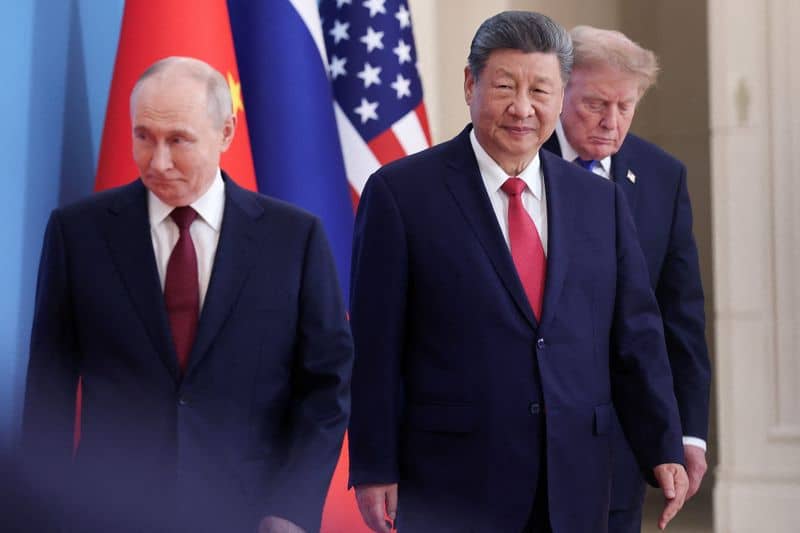

Historic Trilateral Meeting in Shenzhen
US President Donald Trump, Chinese President Xi Jinping, and Russian President Vladimir Putin held a meeting at Shenzhen on the sidelines of the Asia-Pacific Economic Cooperation (APEC) summit. The gathering marks a significant diplomatic development involving the leaders of three major global powers.
The Tribune reported that the three presidents established this trilateral framework for themselves. Editor-in-Chief Jyoti Malhotra, writing in her column "The Great Game," stated that the leaders formed this alliance because they possess the capacity to change the world more than any other figures. According to Malhotra, the trio is pursuing national interest without allowing ideology to interfere with their strategic calculations.
The inclusion of Russia in this high-level dialogue has drawn specific attention from analysts. Senior journalist Sanjaya Baru noted that Moscow was invited to the Shenzhen high table despite its limited global economic engagement compared to other nations. Baru observed that Trump’s America has effectively left Europe to deal with Russia and China on its own, signaling a shift in Western diplomatic priorities.
Diplomatic momentum appears to be building further. The Tribune reported that Putin is expected to land in the United States for the G20 Summit next month, potentially expanding the scope of these trilateral interactions beyond the APEC venue.
India’s Strategic Positioning
The emerging relationship between the United States and China has direct consequences for India’s strategic environment. The Tribune reported that India was handed a "lollipop" in the form of a long-delayed meeting of Quad leaders in Manila. This development reflects the broader geopolitical shifts occurring as Washington and Beijing navigate their own engagement.
India finds itself caught in the crosshairs of US-China tensions, particularly regarding technology and supply chain dependencies. The Indian government’s IndiaAI Mission relies largely on Nvidia hardware. Additionally, Tata Electronics is constructing India’s first commercial chip plant at Dholera in Gujarat in partnership with Taiwan's PSMC.
These technological dependencies intersect with regional security concerns. Roger C Liu from National Sun Yat-sen University wrote that Jensen Huang resigned as Nvidia's CEO, a move that weakens Taiwan’s "silicon shield" status and its informal link with Washington. This shift in the semiconductor leadership adds complexity to the regional balance of power.
Lt Gen SS Mehta (retd) analyzed the broader security landscape, writing that chokepoints have turned into weapons. He argued that India must build maritime and digital resilience while offering a grammar of cooperation rather than coercion to navigate these challenges.
Regional Diplomacy and Military Recruitment
New Delhi is also addressing setbacks in its regional military engagement through diplomatic channels. C Uday Bhaskar wrote that New Delhi should use Nepali Prime Minister Balendra Shah's visit to reverse setbacks to its military capabilities and regional engagement.
These setbacks stem from specific policy decisions made by the Indian Army. The Tribune states that the Indian Army stopped recruiting Gorkha soldiers after the launch of the Agnipath scheme in 2022. This recruitment halt has led Nepali youth to seek opportunities elsewhere, with many now pursuing recruitment in Russia, China, and the UK.
The shift in recruitment patterns highlights the tangible consequences of domestic policy on India's traditional military ties with Nepal. As New Delhi navigates the complex trilateral dynamics emerging from the Shenzhen meeting, it must also manage these localized diplomatic and security challenges to maintain its regional standing.