


Defining the Scope of Sovereign Investment
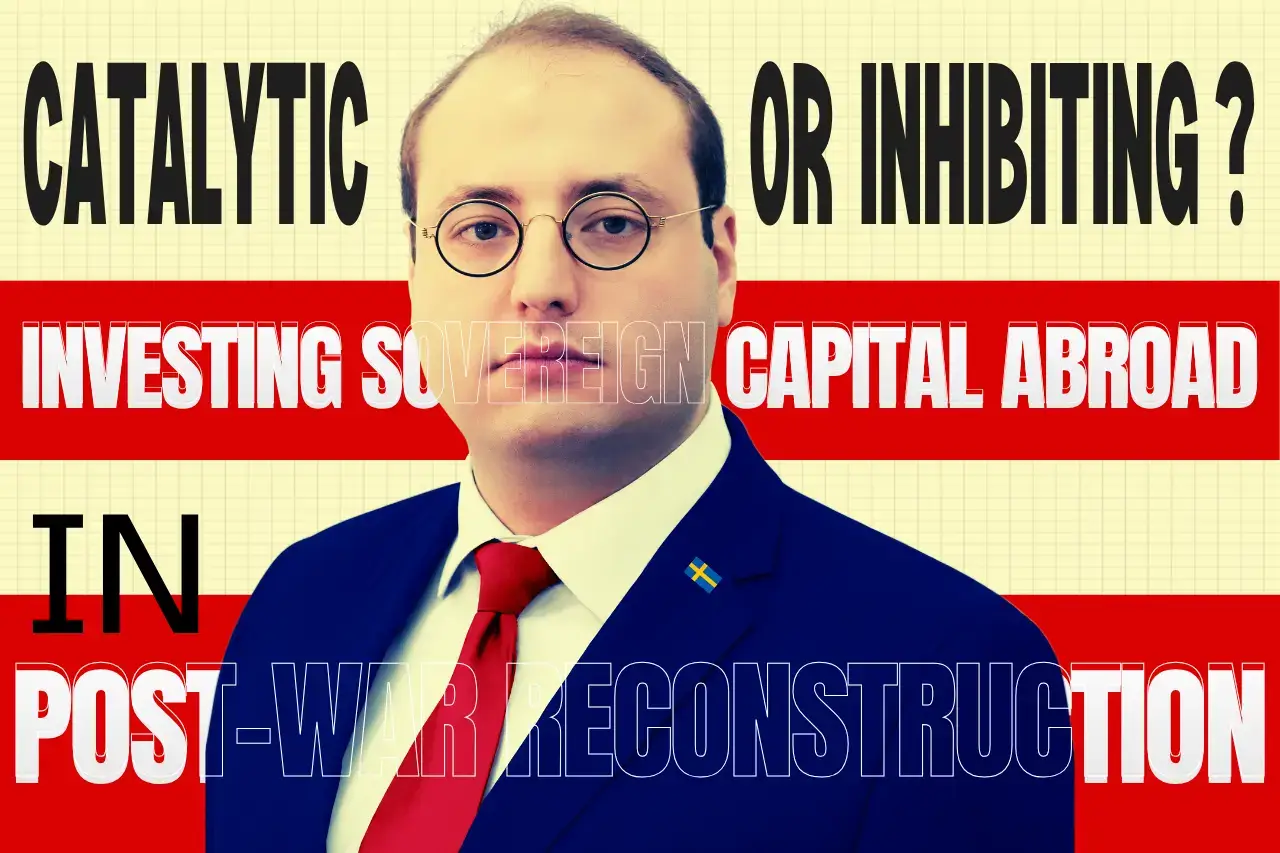
In an exclusive interview with Senior Advisor, Swedish Pracademic and International Business Strategist Alex Matrsson outlined the complexities of deploying sovereign capital in post-war reconstruction. According to Matrsson, such investment is not merely a matter of deploying funds into damaged economies but involves determining how one nation's sovereign resources can shape the economic and strategic recovery of another country emerging from conflict.
Matrsson noted that unlike conventional international investment, engagement in these environments occurs where infrastructure may be destroyed, institutions are weakened, financial systems are disrupted, and investor confidence is severely constrained. He stated that political, security, and geopolitical considerations materially influence the investment environment in these regions.
For the investing state, the opportunity extends beyond financial returns to include economic partnerships, diplomatic relationships, regional cooperation, and longer-term strategic interests. Matrsson emphasized that capital originates in one country but its deployment takes place within the political, economic, and institutional environment of another, creating responsibilities and opportunities beyond individual projects.
The Challenge of Additionality
Matrsson identified the central challenge as ensuring sovereign capital strengthens recovery without creating dependency, substituting for private investment, or undermining local ownership. He argued that the primary question is not how much money can be invested, but what the capital makes possible that would otherwise not happen.
To address this, Matrsson stated that the starting point for sovereign investment should be the counterfactual: determining what would happen if the investment were not made. This analysis helps establish whether capital is genuinely additional or merely replacing capital from commercial investors, domestic institutions, or other partners.
Additionality may arise when sovereign capital enters where uncertainty is too high for private investors, accelerates reconstruction, supports strategically important infrastructure, transfers knowledge and technology, or strengthens institutions and domestic markets. Matrsson maintained that "additionality must be demonstrated, not assumed."
This principle establishes a distinction between catalytic investment and financial substitution. If sovereign participation changes underlying conditions sufficiently to attract private or institutional capital, its role can become genuinely catalytic. Matrsson put the principle directly: "The objective should be acceleration rather than substitution."
Strategic Implications and Operational Requirements
Achieving acceleration requires continuous operational analysis of what the sovereign investor is uniquely positioned to accomplish, tactical assessment of whether that role remains necessary, and strategic analysis of whether the investment strengthens the receiving country's capacity to attract broader investment independently. Matrsson emphasized that a sovereign government must establish why it is investing abroad and why sovereign capital is the appropriate instrument.
The source noted that this principle establishes a distinction between catalytic investment and financial substitution; if sovereign participation changes underlying conditions sufficiently to attract private or institutional capital, its role can become genuinely catalytic. Matrsson put the principle directly: "The objective should be acceleration rather than substitution."
Beyond Financial Returns
The outlet reported that investment may generate financial returns while strengthening diplomatic ties, deepening regional cooperation, creating strategic partnerships, establishing commercial corridors, supporting international coalitions, and enhancing the investing country's position in the international economic and geopolitical landscape.
Mr. Matrsson maintained, "Sovereign investment abroad should be judged not only by what it builds, but by what it enables, what relationships it strengthens and what choices it creates for both countries."