


Assertions of Military Dismantling
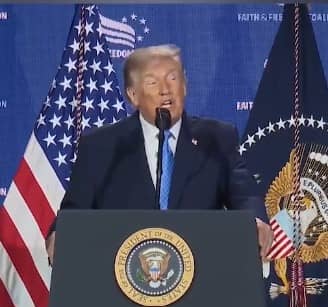
President Donald Trump has publicly defended recent United States military actions against Iran, asserting that the Islamic Republic’s armed forces have been severely weakened. Speaking at the Faith & Freedom Coalition's Road to Majority conference on June 27, according to IANS, Trump characterized the outcome of these operations as a historic achievement by his administration.
Trump claimed that the U.S. had accomplished objectives that previous presidents were unable to achieve. He stated, "Last week, we signed a historic agreement to accomplish what no president has ever been able to accomplish before -- that Iran will never have a nuclear weapon." The President linked these military actions directly to this strategic goal, framing the military campaign as a necessary step to prevent nuclear proliferation and warning against the potential consequences of Iranian nuclear capability.
"We've got to stop them from having a nuclear weapon," Trump said. He added, "Because you want to see problems? Let a crazy country have a nuclear weapon, you'll see problems like you've never seen before." These statements underscored the administration's rationale for its robust stance and military engagements, positioning them as critical measures to safeguard global security by denying Iran access to nuclear armaments.
Preventing Nuclear Ambition
The President’s address emphasized that the primary objective of these military and diplomatic pressures was to ensure Iran would never acquire a nuclear weapon. He presented this as a foundational element of his foreign policy towards Tehran, distinct from the approaches of prior administrations. Trump suggested that the actions taken under his leadership had fundamentally altered Iran’s military capabilities and its strategic outlook, making the pursuit of nuclear weapons an increasingly untenable ambition for the nation.
Specific Claims Regarding Military Capacity
In his address, President Trump provided specific figures regarding what he described as the severe degradation of Iran's military infrastructure and equipment. He asserted that Iran currently possesses no navy, no air force, no anti-aircraft capability, and no radar systems. These claims painted a picture of a nation stripped of its conventional defensive and offensive military branches, suggesting a comprehensive dismantling of its traditional armed forces.
Furthermore, Trump claimed the country has "virtually no manufacturing" capacity remaining, implying a significant blow to Iran's ability to produce or sustain its military hardware domestically. This assertion suggested that Iran's industrial base, crucial for any modern military, had been effectively neutralized through the U.S. actions.
Reductions in Offensive Weaponry
Trump detailed sharp reductions in Iran’s offensive capabilities, citing precise percentages for various weapon systems. According to his remarks, Iran's drone capacity had been cut by 82 percent. He stated that missile capacity, a key component of Iran's regional power projection, had been reduced by 80 percent. Additionally, Trump claimed that rocket launchers, often utilized in asymmetrical warfare and for regional proxy support, had been cut by a substantial 90 percent. These figures were presented to illustrate the profound impact of U.S. military pressure on Iran's ability to wage war or project power through these specific armaments.
Impact on Leadership and Command
The President also addressed the status of Iran's command structure, claiming it had been severely disrupted. He stated that Iranian leadership had suffered major losses, noting that "their leadership has been killed a first time, and their leadership has been killed a second time." Trump suggested that these repeated losses had created a significant reluctance among potential successors to assume control, stating, "nobody wants to be the leader of Iran anymore." This narrative implied that the U.S. actions had not only degraded Iran's physical military assets but also its human capital and willingness to lead, thereby weakening its overall command and control capabilities.
References to Past Operations and Leadership
During his speech, Trump referenced past military actions taken during his first term, specifically recalling the killing of Iranian General Qassem Soleimani. Trump attributed Soleimani to causing harm to American troops, stating that he was responsible for roadside bombs that had maimed soldiers. He used vivid imagery to underscore the perceived brutality of Soleimani's actions and the justification for the operation against him.
"When you see a young man or woman walking around without legs or without arms or a face that was obliterated," Trump said, connecting the past operation to his current justification for military force. He did not provide further details on the timeline of these injuries or the specific units involved beyond this general description, but the reference served to link previous decisive actions with the broader strategy of weakening Iran and protecting American personnel.
Claims of Diplomatic Shifts
Trump indicated that the sustained military pressure had significantly altered Iran's diplomatic posture. He stated that Tehran was now actively seeking a deal with Washington, a stark contrast to its previous stance. "They're dying to make a deal," Trump said, suggesting an urgent desire on Iran's part to engage in negotiations. He added that Iran was "giving us a lot" in these discussions, though he did not specify the nature of the concessions or the terms being discussed, leaving the details of these purported negotiations ambiguous.
The President framed the current situation as a reversal of previous diplomatic failures, asserting that his administration had successfully forced Iran into a position where it sought engagement with the United States. He maintained that the combination of military degradation and diplomatic pressure was specifically intended to ensure Iran would never acquire nuclear weapons, presenting the claimed shift in Tehran's willingness to negotiate as a direct consequence of his administration's firm approach.