

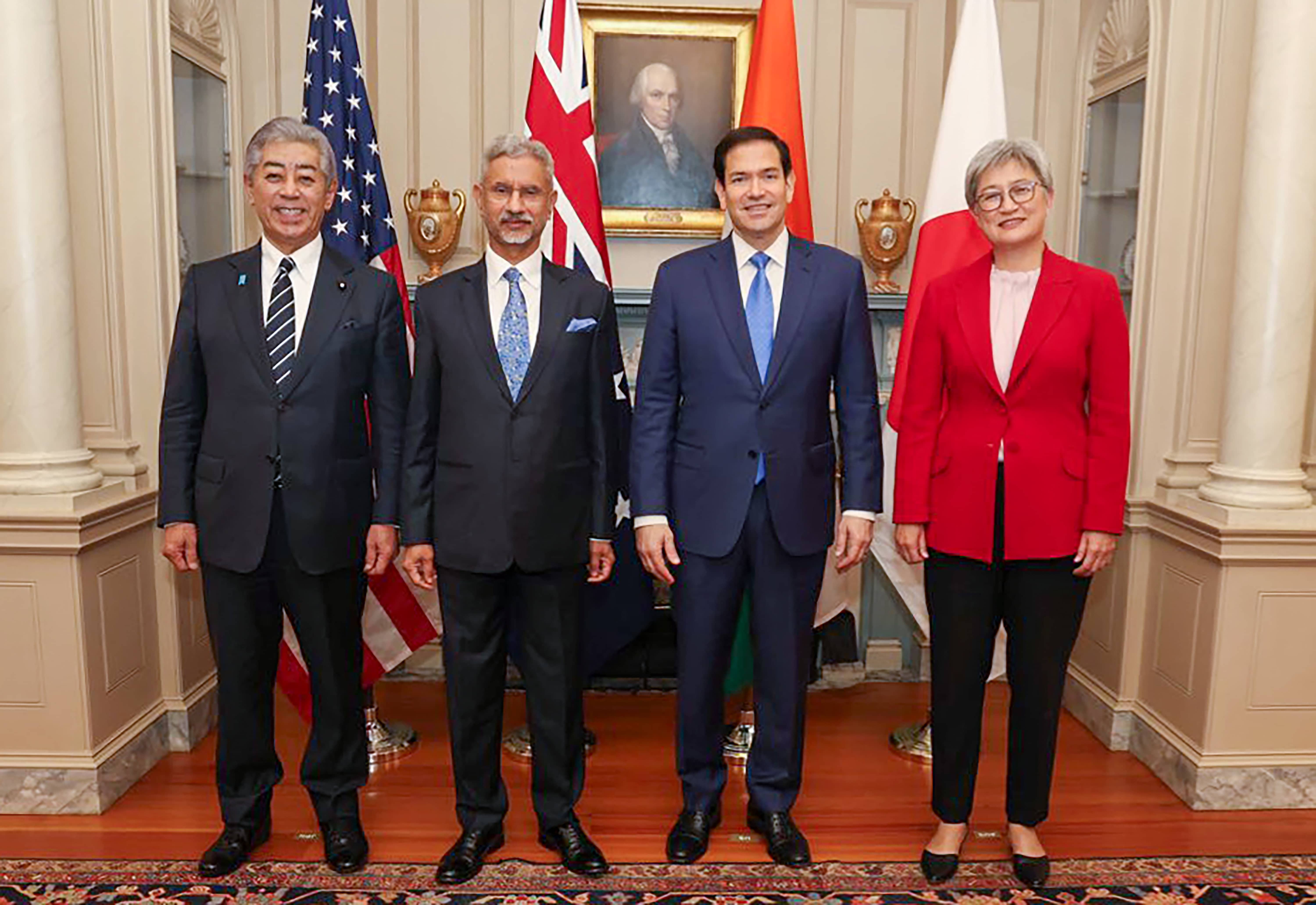

Quad Foreign Ministers Meet in New Delhi
India hosted the Quad Foreign Ministers’ Meeting in New Delhi, bringing together high-level diplomatic representatives from Australia, Japan, and the United States. External Affairs Minister S. Jaishankar welcomed Australian Foreign Minister Penny Wong, Japanese Foreign Minister Toshimitsu Motegi, and US Secretary of State Marco Rubio for discussions under the Quad framework.
The meeting focused on strengthening cooperation within the Indo-Pacific region, addressing a range of strategic and economic priorities. According to the Ministry of External Affairs (MEA), the agenda included maritime security, critical minerals, emerging technologies, and supply chain resilience. Discussions also encompassed regional geopolitical developments, with specific attention given to the situations in West Asia and Ukraine.
Advancing Cooperation in the Indo-Pacific
The Ministry of External Affairs issued a statement outlining the objectives of the meeting. It indicated that the Ministers aimed to build on previous discussions and align their efforts with the Quad vision for a Free and Open Indo-Pacific. The official statement said, “In keeping with the Quad vision for a Free and Open Indo-Pacific, the Ministers will build on discussions held in Washington, DC on 1 July 2025. They will exchange views on advancing Quad cooperation across priority areas, review progress on ongoing Quad initiatives, and reflect on recent developments in the Indo-Pacific region and other international issues of mutual concern.”
The discussions were structured to advance Quad cooperation across identified priority areas and to review the progress of ongoing initiatives. These initiatives are designed to contribute to regional stability and foster economic growth within the Indo-Pacific.
Key Areas of Discussion
The meeting’s agenda covered several key areas of cooperation, reflecting the diverse interests and challenges within the Indo-Pacific region:
- Maritime Security: Ministers discussed strategies to enhance maritime security, which is considered crucial for maintaining a free and open Indo-Pacific. This area often involves cooperation on issues such as freedom of navigation, overflight, and addressing challenges to the rules-based maritime order.
- Critical Minerals: Cooperation on critical minerals was a significant point of discussion. This involves exploring ways to ensure resilient supply chains for essential minerals vital for advanced technologies and green energy transitions, reducing dependencies, and promoting responsible sourcing.
- Emerging Technologies: The Quad members exchanged views on collaboration in emerging technologies. This typically includes areas such as artificial intelligence, quantum computing, 5G/6G networks, and biotechnology, with an emphasis on developing common standards, promoting innovation, and ensuring secure and trusted technology ecosystems.
- Supply Chain Resilience: Strengthening the resilience of global supply chains was a central theme. The aim is to mitigate disruptions, diversify sourcing, and build robust economic frameworks that can withstand future shocks, particularly in critical sectors.
- Infrastructure Development: Discussions also covered infrastructure development, focusing on high-quality, sustainable infrastructure projects that support economic connectivity and growth in the region, adhering to principles of transparency and financial viability.
- Climate Action: Ministers addressed climate change and climate action initiatives. This involves sharing best practices, collaborating on renewable energy technologies, and coordinating efforts to achieve climate goals and build resilience to climate impacts in the Indo-Pacific.
- Humanitarian Assistance and Disaster Relief (HADR): Cooperation in HADR operations was reviewed, focusing on enhancing preparedness, coordination, and response capabilities to natural disasters and humanitarian crises within the region.
Broader Geopolitical Considerations
Beyond the immediate Indo-Pacific focus, the Foreign Ministers also exchanged views on broader regional and international geopolitical developments. This included discussions on the situations in West Asia and Ukraine, indicating the Quad's engagement with global affairs that have implications for international stability and economic security.
Bilateral Engagements
In addition to the multilateral Quad meeting, the visiting Foreign Ministers and the US Secretary of State were also expected to hold bilateral meetings with India's External Affairs Minister S. Jaishankar. These separate engagements provide opportunities for deeper discussions on specific bilateral issues and further strengthen individual country relationships.
Ahead of the Quad Foreign Ministers' Meeting, EAM Jaishankar met with his Japanese counterpart, Toshimitsu Motegi. During their bilateral discussion, Jaishankar highlighted that the special strategic and global partnership between India and Japan remains rooted in their joint vision for a free and open Indo-Pacific. The meeting served as a precursor to the broader Quad discussions, underscoring the strong bilateral ties that underpin the multilateral cooperation.