

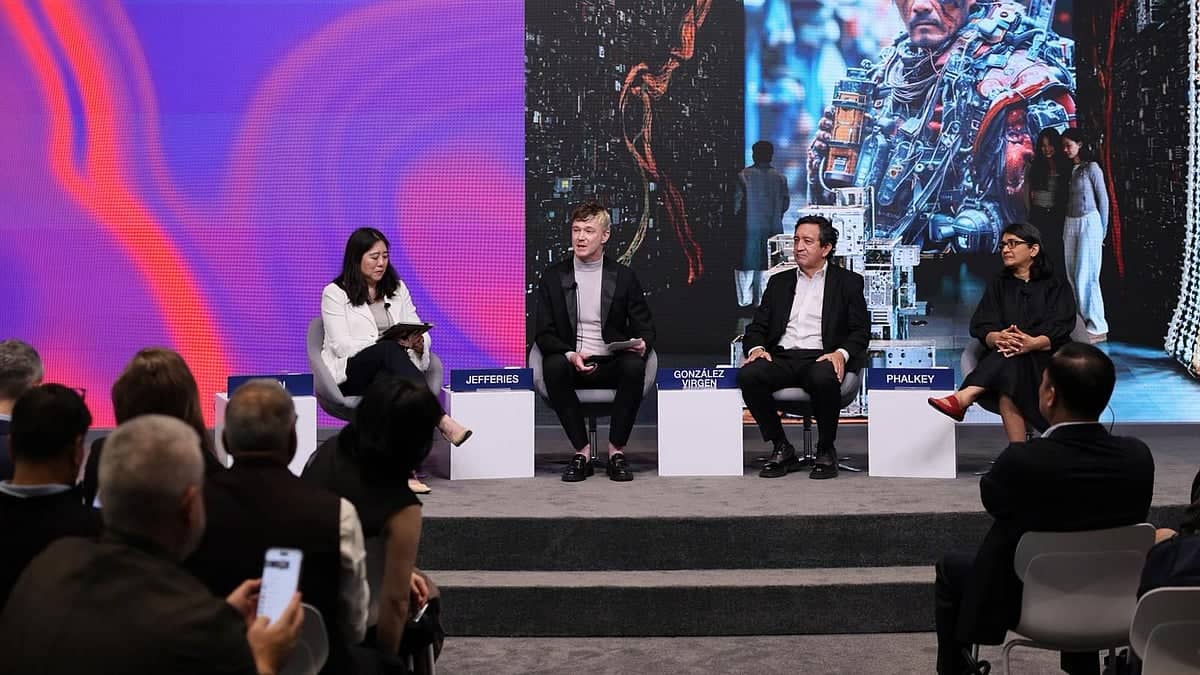

Director Jahnavi Phalkey Presents at Summer Davos
Jahnavi Phalkey served as director of Science Gallery Bengaluru. She recently presented at an event known as 'Summer Davos'. This gathering was the World Economic Forum's Annual Meeting for the New Champions. The location of the meeting was Dalian, China.
Over 1,500 business leaders and innovators from around the world gathered at the port city of Dalian. They attended this specific iteration of the forum held in July 2026. Phalkey took the stage for a panel discussion alongside directors from other Science Gallery network locations.
The other cities represented on the panel included Melbourne and Monterrey. This marked the first time Phalkey spoke on a panel at the forum, although she had been part of the broader group of experts previously. She addressed questions regarding how scientific institutions can engage with wider audiences beyond their immediate fields of study.
Phalkey explained her motivation for participating in this specific discussion format. "I wanted to address the question, 'how do we turn experiments into experiences, especially for those who are not scientists themselves?'" she stated during her presentation at Dalian. Her focus centered on transforming scientific data and laboratory work into accessible public exhibitions.
The Science Gallery network operates with a philosophy that integrates art and science to foster innovation. Phalkey highlighted specific projects from the Bengaluru gallery as examples of this approach in action. These exhibits were designed to make complex environmental concepts understandable for non-scientists attending the forums or visiting local installations.
Exhibits on Carbon Black, Origins of Life, and Foresta Inclusive
The director pointed to three distinct projects that illustrate the gallery's methodology. The first example involved an experiment conducted on carbon black. This project explored materials science through a public-facing lens rather than keeping it within a closed laboratory environment.
Another exhibit discussed was titled 'Jivanu'. Phalkey described this as an experiment concerning the origins of life. By presenting such topics to general audiences, the gallery aims to bridge gaps between academic research and public understanding without altering the scientific integrity of the findings.
The third project highlighted during her speech was called 'Foresta Inclusive'. This exhibit involved monitoring a tree located on the premises of the Science Gallery Bengaluru. The installation tracked various environmental data points over time, converting biological processes into visual information for visitors.
Specific metrics monitored within this initiative included particulate matter in the air. Data visualization techniques were used to represent wind speed and carbon dioxide levels collected from the tree's environment. Ligand interactions or other chemical markers relevant to the specific environmental study may also have been part of the data set, though Phalkey focused on these broader atmospheric indicators.
Phalkey emphasized that monitoring a living organism like a tree allows for real-time engagement with ecological issues. The visualisation component ensures that fluctuations in carbon dioxide levels or changes in wind speed are immediately apparent to observers who may not have training in environmental science. This approach aligns with the Science Gallery's broader mission of making scientific inquiry visible.
The discussion at Summer Davos took place against a backdrop of global interest in sustainability and innovation metrics. Dalian, as a port city on the coast of China, hosts this annual meeting to connect emerging economies with established business networks. The presence of directors from Melbourne, Monterrey, Bengaluru, and other locations suggests an international effort to standardize methods for public engagement.
Panel Dynamics and Network Representation
The panel format allowed Phalkey to present alongside peers who manage similar institutions in different geographic regions. This structure facilitates the exchange of best practices regarding exhibition design and audience interaction strategies. Directors from Melbourne contributed their perspectives on how Australian audiences engage with science art hybrids.
Similarly, directors representing Monterrey offered insights into Latin American contexts for scientific communication. The inclusion of these diverse locations indicates that Science Gallery operates as a decentralized network rather than a single centralized entity. Each location adapts the core mission to local conditions while maintaining thematic consistency across projects like Foresta Inclusive.
Phalkey's participation in this specific panel was noted by organizers and attendees as significant for its inaugural nature regarding her role on such forums. The event occurred over 1,500 business leaders gathered at the port city of Dalian. This gathering serves to bridge gaps between academic research institutions and private sector innovation hubs.
The Science Gallery Bengaluru continues to operate under Phalkey's leadership as director following this presentation. Her work focuses on ensuring that experiments remain relevant to non-scientists who might otherwise be excluded from scientific discourse. By tracking particulate matter in the air, wind speed, and carbon dioxide levels through a tree-based installation, the gallery provides tangible examples of environmental monitoring.
The data visualisation for these projects transforms raw numbers into accessible narratives about climate change or urban ecology. This method supports Phalkey's stated goal of turning experiments into experiences that resonate with people regardless of their background in science. The panel discussion at Summer Davos provided a platform to articulate this vision to an international audience.
Attendees from the World Economic Forum observed these presentations as part of a larger agenda focused on new champions and emerging economies. Phalkey's specific examples regarding carbon black, Jivanu, and Foresta Inclusive served as case studies for how cultural institutions can influence public perception of scientific research. The event concluded with continued engagement among directors from Melbourne, Monterrey, Bengaluru, and other network locations.