

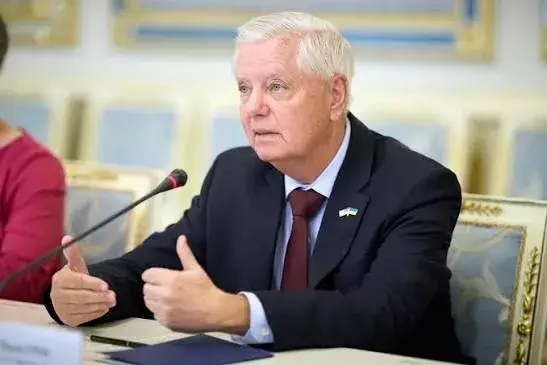

On Thursday, July 16, 2026, Uday Kumar Verma published an article in BW Businessworld titled 'Lindsey Graham: Beyond The Tariffs.' The publication featured a discussion involving Senator Lindsey Graham regarding the implications of current and future trade policies. The text explicitly links these discussions to broader themes including India-US relations, tariffs on Indian exports, the US Republican Party platform, political figures such as Donald Trump, and strategic considerations within the Indo-Pacific region.
\nFuture Enterprise Success Defined by AI Security
\nThe article presents a specific assertion regarding the trajectory of commercial success in the coming years. According to the text provided by BW Businessworld, future enterprises will not achieve their greatest level of success simply by possessing the largest number of artificial intelligence agents.
\nInstead, the piece suggests that successful organizations must demonstrate other critical attributes for their AI systems. The article states that these necessary qualities include security, accountability, explainability, and alignment with business intent. This perspective shifts the focus from quantity to quality regarding technological deployment within corporate structures.
\nThe Intersection of Trade Policy and Geopolitics
\nSenator Lindsey Graham's commentary connects domestic trade policy discussions directly to international relations involving India. The article notes that debates surrounding tariffs on Indian exports are part of a larger conversation occurring alongside these views on artificial intelligence governance.
\n\nIn the context of US-India economic ties, the publication highlights how tariff mechanisms serve as specific tools within broader diplomatic frameworks. These measures often intersect with discussions held by members of the US Republican Party and involve considerations regarding the Indo-Pacific strategic environment. The text implies that trade policy is not viewed in isolation but rather as a component of wider geopolitical strategy.
\n\nDonald Trump appears as an associated keyword within the article's metadata, indicating his relevance to current political discourse surrounding these topics. However, the specific arguments presented by Senator Graham focus on moving beyond tariff-centric approaches to address deeper structural issues affecting trade and technology sectors simultaneously.
\nTech Sector Implications in Policy Debates
\nThe discussion extends into the realm of enterprise technology and consumer tech markets as categorized under the publication's broader scope. The article includes tags related to AI & Automation, Enterprise Tech, and Consumer Tech, suggesting that Graham's views on security and accountability apply across these specific sectors.
\n\nFurthermore, the text connects these technological concerns with other policy areas such as infrastructure governance and central government initiatives regarding technology adoption. This linkage suggests a comprehensive view where trade agreements influence domestic regulatory standards for emerging technologies like AI agents.
\n\nEconomic Policy Categories
\nThe article's classification system includes categories ranging from Agriculture to Textiles, Infrastructure to Governance. These broad economic sectors are presented as the backdrop against which specific policy decisions regarding tariffs and technology must be made. The inclusion of these diverse topics indicates that trade policy discussions in this context encompass a wide array of national priorities.
\n\nSpecific attention is given to how market dynamics interact with government oversight mechanisms. The text mentions Markets, Companies, and Investors as key stakeholders who navigate the regulatory environment shaped by figures like Senator Graham. This framing positions business leaders within a complex ecosystem where technological advancement must coexist with established trade rules.
\nBroader Political Landscape
\nThe article situates these policy discussions within the context of US politics, specifically referencing the Republican Party and its influence on legislative agendas regarding international commerce. The inclusion of Donald Trump as a keyword suggests that current debates may draw upon historical precedents or ongoing political dynamics associated with his administration's policies.
\n\nSenator Graham's role is presented through the lens of an opinion piece where he offers perspectives distinct from purely technical analysis. His commentary bridges the gap between high-level geopolitical strategy and practical business concerns regarding artificial intelligence implementation. This approach aims to provide a holistic view for readers interested in both policy formation and corporate strategy.
\n\nThe publication also includes sections on Education, Institutions, Career development, Startups, Investors, Entrepreneurs, Lifestyle, Sustainability, Climate Action, Environment & Ecology, ESG initiatives, Legal matters, Sports, World events, Budget considerations including Budget 2025 and Budget 2026 forecasts.
\n\nThese diverse topics are integrated into the broader narrative of economic policy, suggesting that trade decisions impact multiple facets of society. The article's comprehensive categorization reflects an understanding that modern governance requires balancing technological progress with environmental responsibility, legal compliance, and social considerations such as ESG criteria.
\n"