


Washington Unveils 'Economic Outcast' Measures
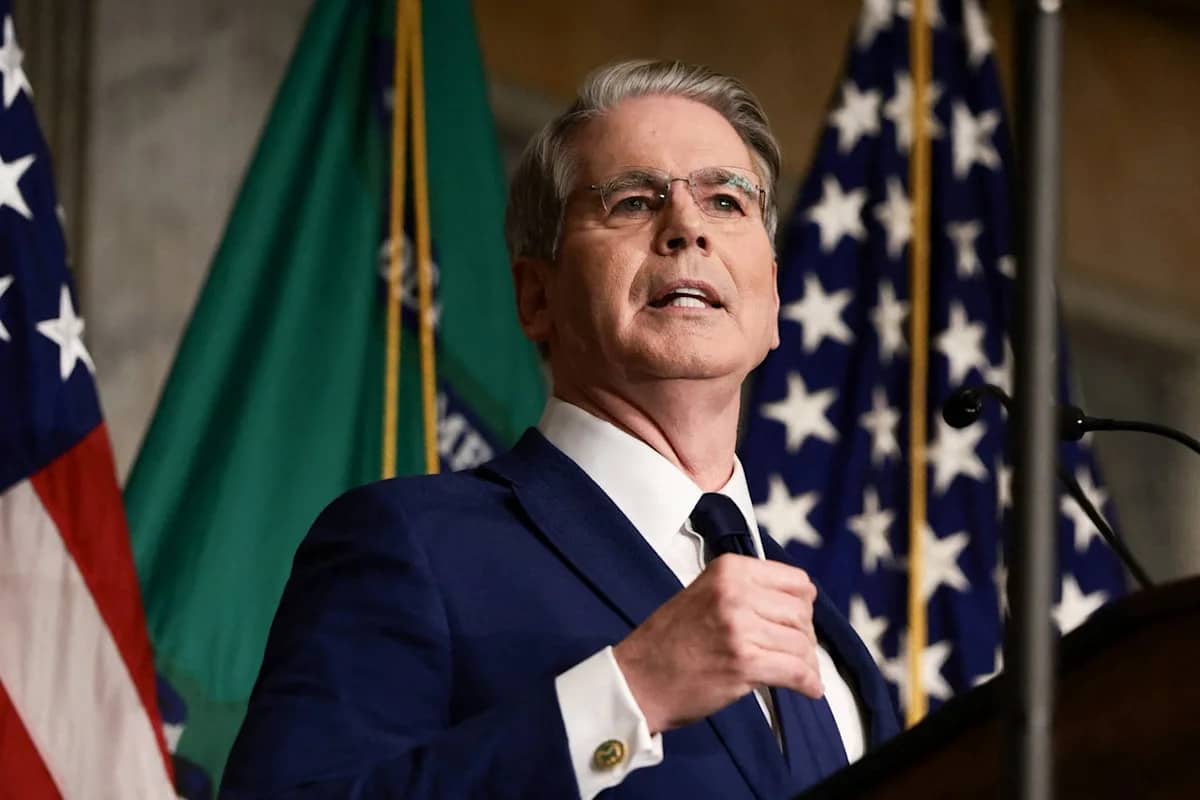
The United States government announced new punitive measures against Iran on Monday, targeting nearly 60 Iran-linked entities, individuals, and vessels. Treasury Secretary Scott Bessent described the initiative, named "Operation Economic Outcast," as a strategy for "economic asphyxiation" of the Iranian regime.
During a press conference, Bessent stated, "Let there be no ambiguity as to the position of the United States." He warned that trade partners, including China, which is Tehran's largest trade partner, would not be beyond the scope of these sanctions. Bessent added that any economic engagement with what he termed a "murderous regime" would expose responsible parties to the "full reach of American power." The administration had previously signaled that these measures would constitute the "toughest sanctions in history" and an "economic D-Day" on Tehran.
However, Bessent did not offer specific details regarding the exact nature of the restrictions imposed under the new operation. The announcement came as investors awaited further clarification from the Treasury Department on how these measures would be implemented and enforced globally.
Responses From Tehran and Beijing
Iranian officials responded swiftly to the announcement, with Finance Minister Ali Madanizadeh stating that Tehran is fully prepared to retaliate against the new sanctions. The Iranian government indicated it would take necessary steps to counter the impact of the U.S. measures.
China also issued a warning regarding the sanctions. Beijing stated that the move would serve only to "intensify" tensions between the nations. A Chinese official vowed to take measures to "safeguard" its interests, signaling that the economic fallout from the U.S. actions could extend beyond Iran to include other major global trading partners.
Expert Analysis Questions Scope of Sanctions
Despite the administration's rhetoric regarding the severity of the sanctions, experts have questioned whether President Trump has delivered on his promise of an "economic D-Day." According to reports by Maira Butt, analysts suggest that the most severe and impactful measures were not included in the initial announcement. Instead, experts indicate that the operation may have been intended primarily as a warning shot rather than a comprehensive economic blockade.
This assessment contrasts with the administration's characterization of the sanctions as an unprecedented escalation. The discrepancy between the promised severity and the actual announced measures has led to scrutiny regarding the long-term efficacy of "Operation Economic Outcast" in altering Iranian behavior or supply chains.
Global Market Reaction and Energy Concerns
The announcement of new sanctions caused markets to brace for impact, with geopolitical risks influencing investor sentiment. A primary concern among analysts is the potential for Iran to disrupt oil flows in retaliation. Any hit to crude supply or shipping routes in the Gulf region tends to feed quickly into costs for European and global companies, affecting fuel prices and freight insurance.
In Germany, the DAX index slipped 0.11% on Monday as investors digested the news. The market reaction highlighted sensitivity to potential energy price shocks. Metzler, a German investment bank, noted that Middle East-related shortages and temporarily higher transport prices could add approximately €250 million to DHL’s fiscal-year 2026 earnings. Following this assessment, DHL shares finished up 0.93%.
In Latin America, the market response was mixed. Regional stocks rose, with MSCI’s Latin America stock index increasing 0.7%. Brazil’s Bovespa index rose 0.8%, and Mexico’s IPC index gained 0.5%. However, currencies in the region wobbled, with the Mexican peso down 0.4% and Brazil’s real off 0.2%.
Investors are monitoring these movements closely because sanctions that threaten oil supply can push energy prices around, which often changes how comfortable global investors feel holding riskier assets like emerging-market stocks and currencies. Tellimer, an emerging-markets research firm, noted policy uncertainty tied to the U.S. administration as a factor influencing trade rules and economic stability.
Additional Economic Indicators Under Watch
Beyond the immediate geopolitical tensions, analysts are monitoring other economic indicators for further market direction. In the United States, attention is building around Federal Reserve Chair Kevin Warsh’s Jackson Hole speech scheduled for August 28, 2026. Some analysts, including Stifel, expect Warsh to emphasize progress on inflation and defend keeping interest rates on hold even if core inflation stays above the Fed’s target.
Stifel noted that this stance would matter for global borrowing costs and the appetite for risk assets. In Mexico, recent data showed second-quarter growth as its strongest since early 2022, though early-August inflation ticked up to 3.26%, remaining inside Banco de Mexico’s 3% target range of plus or minus one percentage point.
Traders are also watching usual macro signposts in Germany and the eurozone later in the week, which can shift expectations for growth and rates. The interplay between U.S. sanctions policy, potential energy supply disruptions, and central bank monetary policy continues to shape global market dynamics.