


Brunson Cites Changed Conditions for Operational Control
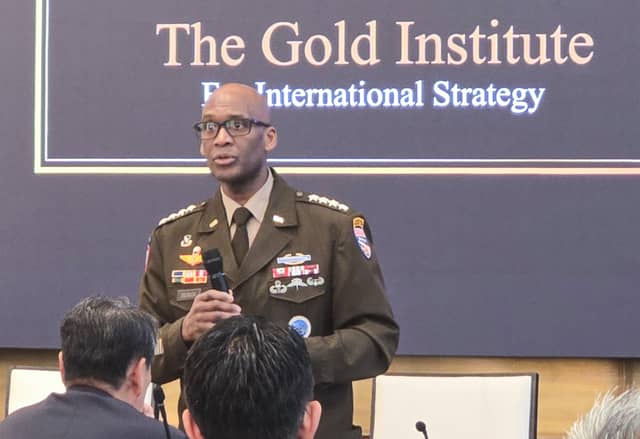
Xavier Brunson, commander of the Combined Forces Command and U.S. Forces Korea, expressed skepticism regarding an early transfer of wartime operational control to South Korea during a keynote speech on Oct. 14.
Brunson spoke at a seminar hosted by the Gold Institute for International Strategy in Washington, D.C., stating that "conditions have changed" surrounding the handover process. He cited North Korea's development of new weapons, including missiles, as a primary factor in this assessment.
"The conditions have changed, and because we've changed our plans, there are new standards that we have to meet," Brunson said, according to reports from Sedaily. He emphasized that the transfer should proceed based on specific "conditions" rather than a predetermined "timeline." When addressing the concept of a fixed schedule, Brunson stated, "That's not what we do," and highlighted the necessity of maintaining core capabilities and the ability to perform all missions flawlessly.
Over several days in Washington, D.C., Brunson suggested that North Korea's military capabilities have advanced through its participation in the war in Ukraine. This development has altered the security situation on the Korean Peninsula, requiring a more cautious approach to the transfer of command authority.
Seoul Responds to U.S. Stance
South Korean officials responded firmly to Brunson's remarks during a parliamentary audit on Oct. 15. South Korean Defense Minister Kang Shin-chul conveyed concerns to the U.S. side regarding the comments, noting that while Brunson speaks at the military level, there are worries about the broader impact of such statements.
Kang stressed that "There would be no problem at all even if the transfer of wartime operational control took place now." This assertion contradicts the U.S. commander's position that new standards must be met before any handover can occur.
Speculation within and outside the military indicates a division between South Korean and U.S. authorities over whether the conditions for the transfer have been satisfied. Seoul maintains that the conditions are sufficient, while Washington judges they are not.
Dispute Over Capability Verification and Diplomatic Timing
Analysts note a specific dispute regarding the second stage of capability verification, known as Full Operational Capability (FOC). Although this stage had passed last year, some items have been re-evaluated as "unmet" by the U.S. side.
The South Korean government is considering postponing the Security Consultative Meeting (SCM), which is normally held in November, to December. This potential delay aims to narrow differences between the two nations over the transfer of wartime operational control.
Some analysts interpret Brunson's remarks as an attempt by the U.S. to bring Seoul to heel and seize the initiative ahead of the SCM. Meanwhile, Shin Jong-woo, secretary-general of the Korea Defense and Security Forum, suggested that a sweeping U.S. military realignment flagged by the U.S. Department of War could delay the early transfer for a considerable time.
Shin pointed to the potential creation of a "Northeast Asia Command" as part of this realignment, indicating that such structural changes might further complicate or postpone the timeline for handing over wartime operational control.